Class 6 Road Base: Depths and Tonnage for Colorado Ground
Also sold as Road Base
Also known as: Class 6, roadbase
Class 6 Road Base compacts into a firm foundation for Colorado driveways and access areas carrying regular heavy traffic.
- Size: 3/4 inch minus
- Grading: Graded mix of crushed stone, gravel and binding fines
- Type: Crushed aggregate blend
From $382 for 1 ton, delivery included
Larger loads cost less per ton: 500 tons is $24,470 ($48.94 per ton). Pick any quantity below for a delivered price.
Free delivery included
Free delivery anywhere in Colorado
Pick a delivery date
Weekday delivery, earliest Oct 20
Get a Free Quote
Fill out the form and our sales team will get back to you within the hour.
Size and Grading
- Size
- 3/4 inch minus
- Grading
- Graded mix of crushed stone, gravel and binding fines
- Type
- Crushed aggregate blend
Ask anyone who has rebuilt a drive on Front Range clay what goes down first and the answer comes back as a number, not a material. Class 6 road base is the layer that decides whether a surface is still flat after three winters of thawing by lunchtime and refreezing by dark. The ground under it swells when it takes on water and shrinks again when it dries, and that movement is what pushes a thin drive into ruts by the second spring.
Why does almost every Front Range drive start with Class 6 road base?
Colorado specifies aggregate base by CDOT class, and Class 6 is the one that ends up under most driveways, parking pads and shed floors. Contractors call it out by number on a plan sheet, yards quote it by number, and a homeowner who asks for "gravel" gets asked back which class they mean.
One thing worth settling early. Class 5 is a separate, heavier structural grade in the same CDOT family. It is not another word for the same material and it is not what ships from this catalogue. What ships here is Class 6 Road Base.
What does 3/4 inch minus actually look like when the pile lands?
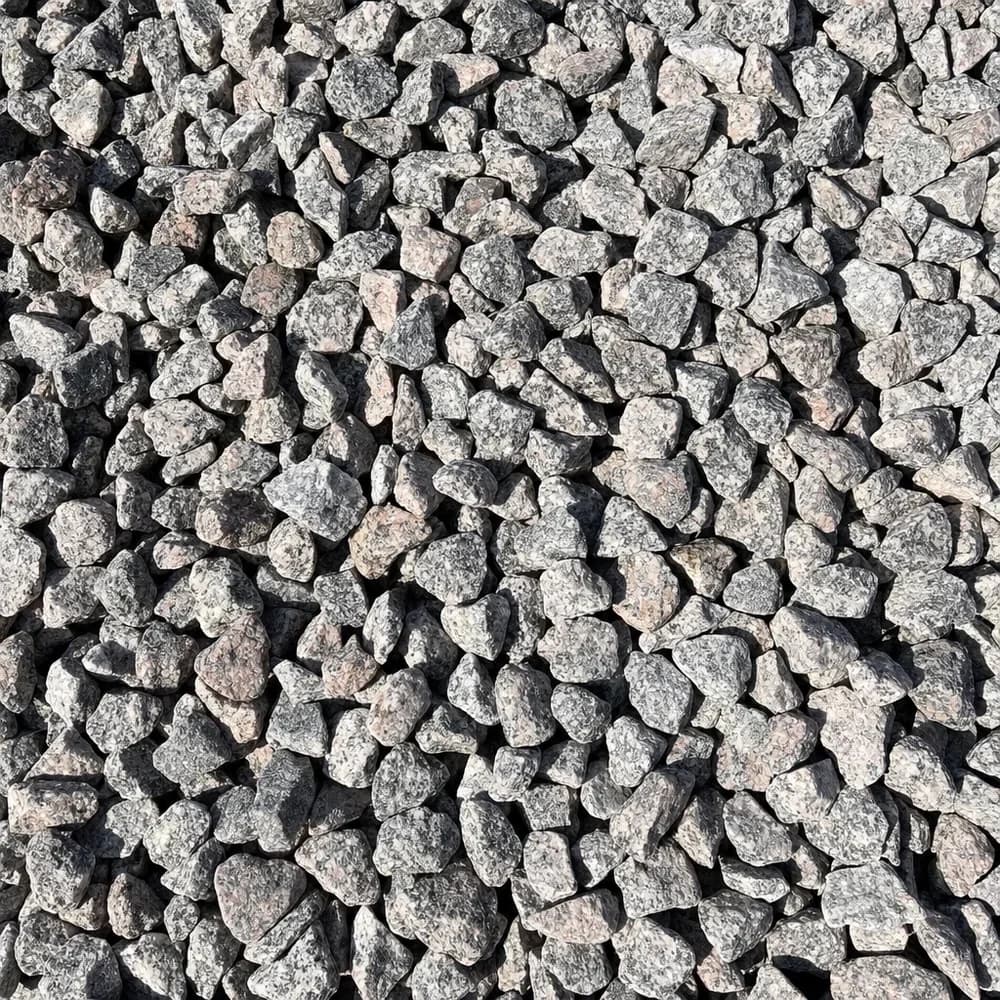
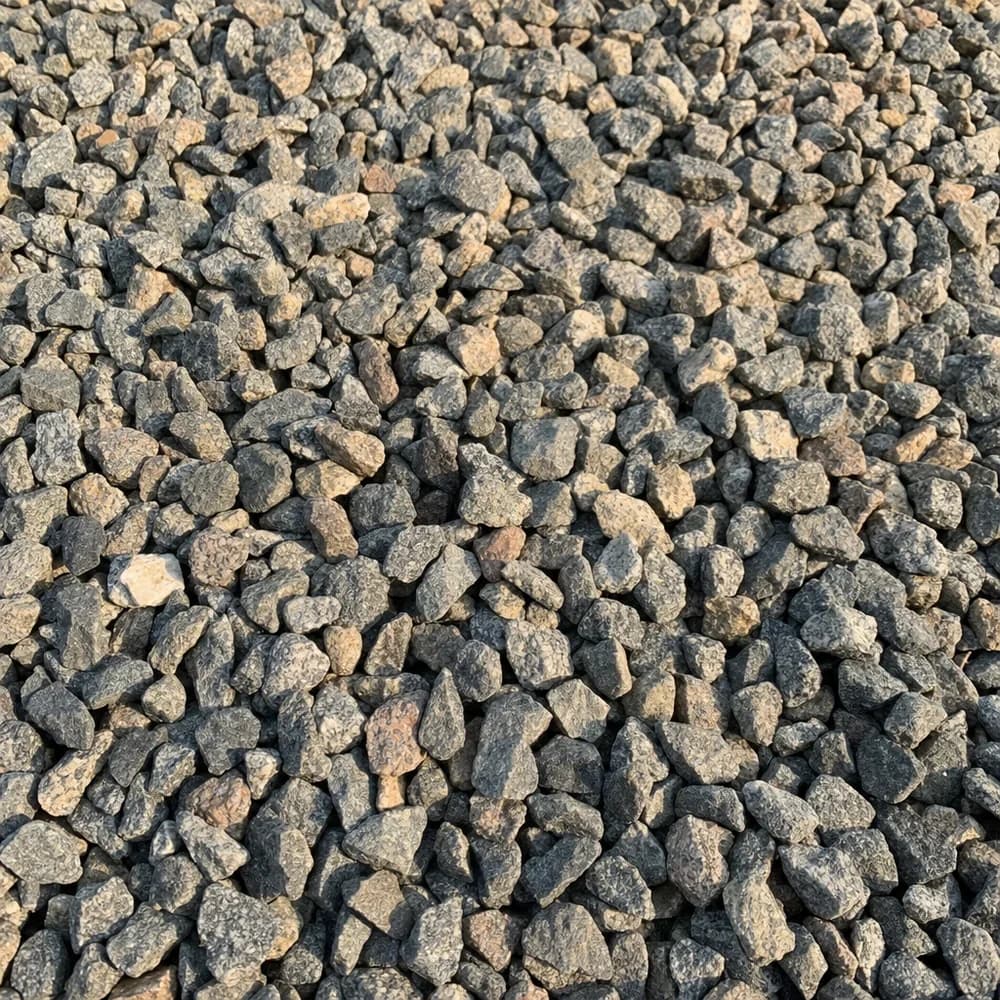
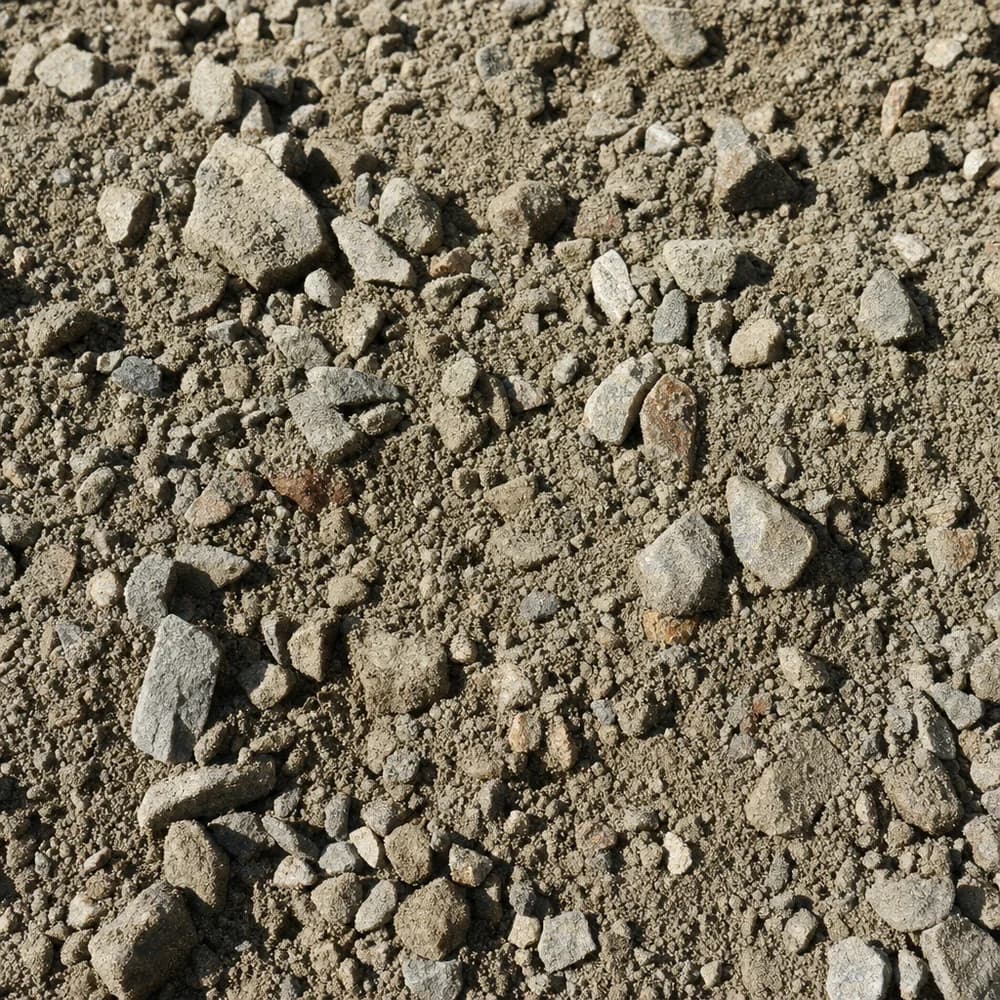
It does not look like landscape stone. Tip a yard out and you get a gray-to-tan construction pile with the biggest pieces about an inch across and every size below that, down to dust. That spread is deliberate. The specification is a graded mix of crushed stone, gravel and binding fines, and each part has a job.
Squeeze a damp handful and it holds its shape. Do the same with clean washed rock and it falls apart in your palm. The large pieces carry the structure, the fines pack the gaps between them, and under a plate or a roller the mass locks up and spreads wheel loads sideways across the subgrade instead of letting them punch through it.
The trade is that those same fines slow water down. A compacted base sheds water off the top, it does not pass water through. That is why a drive wants a crown, and why a trench built to move water wants #57 Stone instead.
What has to be right under the first lift on expansive clay?
Strip the sod and the soft topsoil. Organic material keeps decomposing and compressing for years after you have stopped thinking about it, and a base built over it settles unevenly no matter how many passes the compactor makes.
Then look at the exposed clay. If it is still saturated from snowmelt it will not compact, it will pump. If a slope feeds runoff across the area, catch that water before it gets there rather than burying the problem under rock. Where a low spot needs raising more than a few inches, bring the grade up with Fill Dirt and compact that first, then build the base on top.
Frost goes roughly 30 to 36 inches down through much of the state, so no realistic base depth reaches below it. The goal is not to out-dig the frost. It is to keep water out of the layer and give the rock enough thickness to stay locked together while the ground moves.
Will it carry a pole barn pad with a tractor parked on it?
Yes, if it is built deep enough and in lifts. A pole barn or equipment pad takes concentrated point loads, and a single thick dump compacted once ends up dense on top and loose underneath. Place it in lifts of three to four inches, dampen each lift so the fines bind rather than blow off as dust, and make passes in two directions.
Here is where the depths usually land:
| Job | Compacted Class 6 | Note |
|---|---|---|
| Fire pit surround, foot traffic | 3 to 4 in | One lift, plate compactor |
| Path base under a finer surface course | 3 in | Order the surface layer separately |
| Single-car drive, cars and a half-ton truck | 4 to 6 in | Two lifts on clay, and crown it |
| Pole barn or equipment pad | 6 in and up | Deeper where ground was cut and refilled |
| Patching a rutted stretch | Match the depth beside it | Dig the soft material out, do not bury it |
Does it belong around a fire pit?
It works well there, and it is a cheap way to deal with the ring of grass that dies anyway. A compacted surround gives chairs a flat footing and keeps sparks off dry landscape material.
Take a hypothetical 12-foot circle around a 4-foot pit at 4 inches deep. The ring area is 3.1416 x 6 x 6 = 113.1 sq ft less 3.1416 x 2 x 2 = 12.6 sq ft, so 100.5 sq ft. That is 100.5 x 4 / 12 = 33.5 cubic feet, or 33.5 / 27 = 1.24 cubic yards, which at 1.50 tons per cubic yard comes to about 1.9 tons.
If the ring is meant to look finished rather than gray, compact the base and top it with a couple of inches of River Rock.
How many tons for a 10 by 40 foot single-car drive?
Another hypothetical example, run the way the tool on this page runs it: length and width in feet, depth in inches, divided down to cubic yards, then multiplied by the material weight.
- Area: 10 x 40 = 400 sq ft.
- Volume: 400 x 6 / 12 = 200 cubic feet.
- Yards: 200 / 27 = 7.41 cubic yards.
- Tons: 7.41 x 1.50 = 11.1 tons.
- With the 10 percent the Class 6 calculator adds by default for compaction and spillage: 8.15 cubic yards, 12.2 tons.
Order 13 tons. The same arithmetic on a 30 by 40 foot pole barn pad at 6 inches gives 1,200 x 0.5 = 600 cubic feet, 22.2 cubic yards and 33.3 tons, or about 37 tons once the 10 percent is added. For shapes that are not rectangles, the Class 6 calculator takes circles and up to five separate areas.
When should the load land once mud season is over?
Base work runs most smoothly from late spring through fall. Frozen ground and snowpack will not compact, and a pile dumped on soft spring ground is harder to move than it looks. Pick a dump spot on firm, level ground with clear overhead access, and leave room to work the material out with a tractor bucket or a wheelbarrow.
Set your tonnage and pick a date on this page. Delivery is arranged at checkout by ZIP code, so check your area on the Colorado delivery map first. If the finished surface is meant to stay loose rather than bare base, plan two inches of driveway gravel over the top and order both at once. Depth questions for a particular lot can go through the contact page.
Quickly Calculate How Much You Need
Material: Class 6 Road Base
How to Measure
Measure the length and width of your project area in feet
Decide on depth in inches (2" for landscaping, 4" for driveways)
Enter the values above and we'll calculate the tonnage you need
Need help figuring out the right amount? We can help!
Call or text us at (719) 781-8522 and we'll help you calculate the right quantity for your project.
Not sure how much you need? The Road Base Calculator has depth guides, coverage charts and worked examples for this material.
Frequently Asked Questions About Class 6 Road Base
Class 6 Road Base delivery across Colorado
- Denver
- Colorado Springs
- Aurora
- Fort Collins
- Thornton
- Arvada
- Westminster
- Greeley
- Pueblo
- Boulder
- Longmont
- Castle Rock