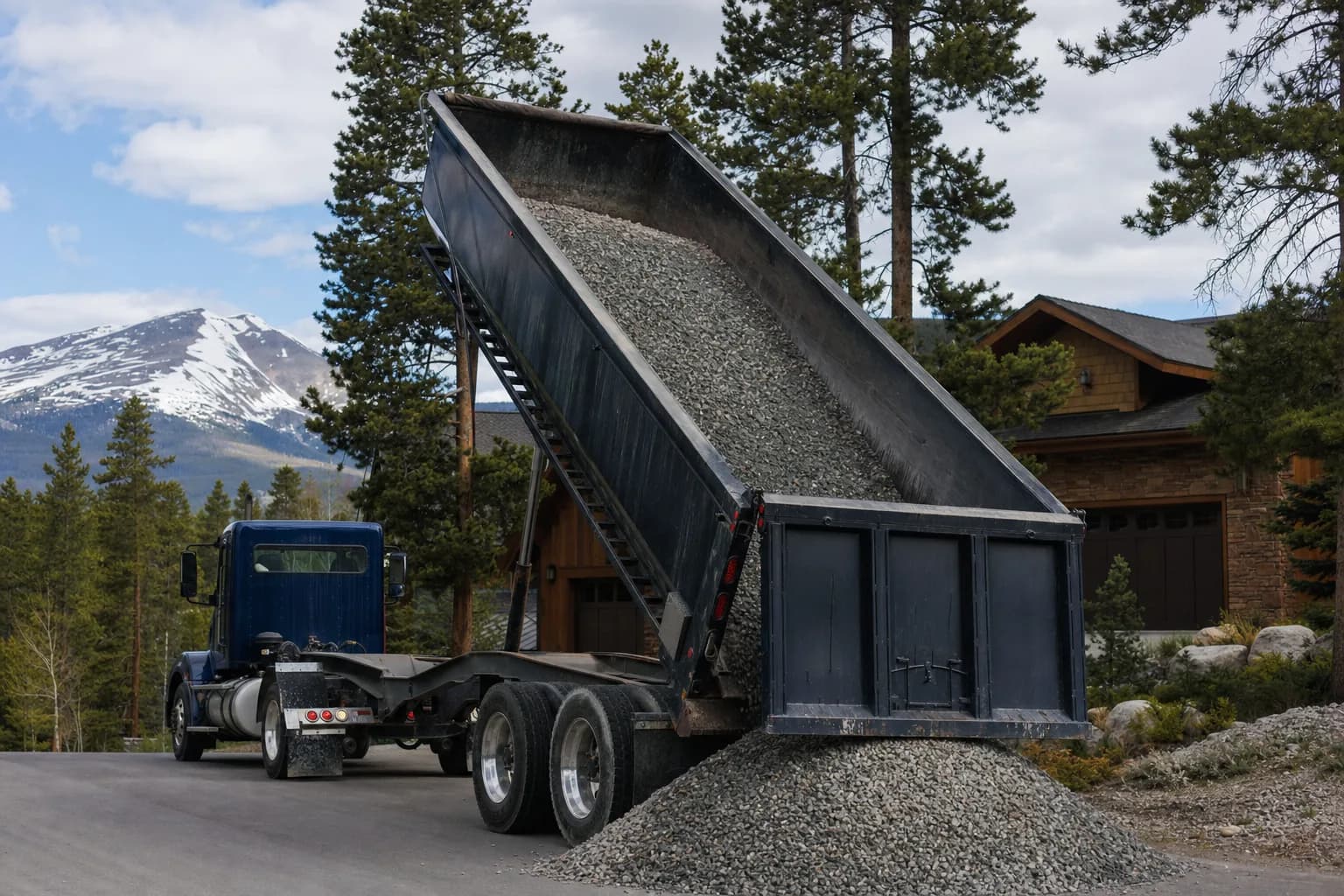
Bulk Material Delivery Through the Colorado Year
The ground you are asking a loaded truck to drive onto is not the same ground in April that it was in September. Clay that carried a pickup all fall turns soft under snowmelt and holds water for weeks, and a drop spot chosen from memory in March is often the worst spot on the property by the time the truck arrives. Bulk material delivery works out easier if the date, the route and the pile location are picked for the season the load is landing in.
Mud season: pick the firm ground, not the convenient ground
From the first real thaw until the ground dries out, the softest spot on most properties is the one nearest the work. Saturated clay ruts under a loaded axle and a truck that sinks is a problem you own. Choose a spot on a compacted drive, a gravel pad or a stretch that drains, even if that means wheelbarrowing further. Keep the pile out of the runoff path as well: meltwater running through a stockpile of base washes the binding fines out of it, and what is left is loose stone.
If the material is going down as well as being delivered, remember that nothing compacts properly while the subgrade is still saturated. It pumps instead of packing.
Summer, when the base work actually gets built
Late spring through fall is the working window for anything structural. The ground takes a plate compactor, the fines bind when you dampen a lift, and a pile can sit a week without turning into a bog. The complication in this stretch is the afternoon storm season, so keep a tarp handy for soil and Shredded Mulch and put Class 6 Road Base down in lifts you can compact the same day rather than opening up more drive than you can finish.
Late fall, and the last week the ground will take a plate
At altitude the freeze arrives earlier than the calendar suggests, and once the top few inches of subgrade are frozen, compaction stops being possible. Base placed over frozen ground slumps when it thaws underneath. If a drive or a pad is going in, aim to land the load with enough daylight left in the season to spread and compact it, not on the last mild weekend of the year.
Snow-covered ground and the spot you cannot see
If a load is landing while there is snow down, the spot is what changes. A driver cannot see a septic lid, a shallow drain line or a soft shoulder under snow, and a marker pushed into a snowbank moves. Clear the spot before delivery day and mark it with something that will still be visible after a squall. Ice on a sloped drive is a good reason to nominate flat ground near the street instead.
What the truck needs, whatever month it is
- A route at least 12 feet wide with no low branches and no overhead wires. Tree limbs that clear a pickup do not clear a raised dump body.
- A firm, level place to tip. The bed has to go up, so nothing overhead and nothing fragile underfoot.
- A visible marker on the dump spot. A cone, a flag or a stake beats a description of the yard.
- Clear access on the day. You do not have to be there, but keep your phone on: if the placement is unclear the driver will call or text.
If the truck cannot reach the spot, the material goes down as close as it can safely be placed, usually the driveway or the ground beside it.
Picking a date that suits the ground, not just the diary
Choose your product and quantity, enter the delivery ZIP code, and pick a date from the weekdays offered. There is a field for where the load should be dropped, so the instruction travels with the order rather than resting on the marker alone. The site's current delivery offer is shown at checkout.
The order is then matched to a supplier in the network near that address, and an agent contacts you to confirm the exact delivery address. The confirmation names the date you chose and a local contact. Unloading on the day runs roughly 10 to 15 minutes.
Work the quantity out first in the material calculator, then order from the product range. You can check an address by ZIP beforehand, and awkward access is worth raising through the contact page before the order rather than on the morning. Changes and cancellations run under the published refund policy, set out in the ordering questions.
Common questions
There is snow down. Will the driver find the spot I marked?
Only if the marker still stands above whatever has fallen since. A stake pushed into a snowbank moves and a cone vanishes in a squall. Clear the spot to a hard surface before the day, set the marker in the cleared patch, and describe it in the drop instructions on the order so the placement does not rest on one object staying put.
When in the year should a driveway rebuild actually be delivered?
Late spring through fall, and earlier in that window rather than later if the property sits high. Compaction needs unfrozen ground and material that can be dampened. A load that lands in deep mud season either sits until the ground dries or gets spread over a subgrade too soft to hold it.
The drive up to the house is steep and ices over. Does that rule out a delivery?
It rules out that spot rather than the delivery. A loaded truck raising a bed needs level, firm footing, and ice on a grade is where a driver stops. Nominate flat ground near the street, mark it, and move the material up in stages. The call confirming your delivery address is the moment to say the drive is the problem.
The load is landing while I am at work. What has to be in place?
An open route, a visible marker and the drop instructions on the order. You do not have to be there. Keep your phone on, because the driver may call or text before tipping, and with unloading running roughly 10 to 15 minutes a missed call is the only thing likely to move the pile.
Ready to Place an Order?
Every order includes free delivery. Browse materials, use the calculator, and submit your order today.