Class 6 Road Base Calculator for Lanes, Pads and Yards
Enter your project dimensions
By the end of August the decision on a rough lane is usually not which material to buy. It is whether the job happens this year or waits until next. The monsoon storms have finished cutting ruts, the ground has dried enough to roll, and there are maybe eight weeks left before frozen subgrade makes proper compaction impossible at altitude. That window is short enough that most people want a tonnage before they want anything else, which is what this road base calculator is for.
Building in the dry weeks between storm season and hard frost
Base work behaves differently at either end of the year. In spring the subgrade is still giving up snowmelt, and rolling a lift over saturated clay pumps water up through it instead of tightening it. In late autumn the top inch can freeze overnight and thaw by noon, so a lift that looked compacted at four o'clock is loose again the next morning.
The reliable stretch runs from late spring, once the ground has drained, through to the first hard freezes. Inside it, the depth you choose matters more than the date. Frost reaches somewhere around thirty to thirty-six inches in much of this state, the clay underneath swells and shrinks with moisture, and a shallow base over that ground is the first thing to fail. Where a lane already ruts every spring, the problem is nearly always water rather than tonnage, and another two inches of stone laid over a wet subgrade will not fix it.
Walking the centerline with a tape before you type anything
Lanes are rarely the rectangle they look like on a plan.
Walk the length along the middle of the running surface rather than down one edge, because the outside of a curve is longer than the inside and the difference over a couple of bends is real. For width, measure in three or four places and use the average, not the widest point where a turning tractor has spread the edge.
Depth is the number to be strict about. Everything on this page is compacted depth, meaning the thickness you want after the roller has been over it. Loose base drops noticeably as it is rolled, so a lane spread four inches loose is not a four-inch lane.
Turn-outs, a widened gate apron and a parking spur at the house are separate shapes. Enter them as their own areas instead of stretching the lane width to swallow them.
A 220-foot lane at six inches in the road base calculator
A hypothetical example: an acreage lane 220 feet long and 11 feet wide, built to six inches compacted.
- Choose Rectangle. Use Add another area for the gate apron if you have one, up to five areas.
- Length 220, width 11, both in feet, giving 2,420 square feet.
- Depth 6, in inches. The field takes anything from 0.25 to 24.
- Select the material so the base weight is applied rather than a lighter one.
- Leave Add 10% extra for compaction & spillage ticked. It is a tick box, on when the page loads; untick it if you want none.
- Calculate, and read cubic yards, tons and cubic feet.
The arithmetic: 2,420 square feet multiplied by 6 and divided by 12 is 1,210 cubic feet. Divided by 27 that is 44.8 cubic yards. Class 6 Road Base is published on this site at roughly 3,000 lb to the cubic yard, which the tool reads as 1.50 tons per yard, so 44.8 yards comes to 67.2 tons. With the ten percent ticked, 49.3 cubic yards and 73.9 tons.
Call it seventy tons, and lay it in two lifts with a roll between them rather than one deep pass.
What the three outputs mean when the order runs to seventy tons
The panel returns cubic yards, tons and cubic feet for the same material, and on a lane this size each one earns its place.
Cubic yards is how you plan the build. Lifts, spreading passes and the size of the heap are all volume, and a yard is 27 cubic feet, roughly a cube three feet on a side before it slumps.
Tons is how base is sold and hauled, so it is the figure that goes on the order. The conversion is that published 1.50, which is why base weighs more per yard than clean stone at about 1.40 or sand at about 1.35. Cubic feet is the raw volume, worth glancing at only if you are checking the sums on paper.
A quicker sense check while you are standing in the lane: at six inches compacted, a ton of base covers somewhere around 36 square feet. At four inches it stretches to about 54. Multiply that out in your head and if it lands nowhere near the screen, something has been typed in the wrong unit.
Lanes, RV pads and a container corner: depth by what rolls on it
Depth follows the heaviest thing that will ever sit on the surface, not the average traffic.
- A light residential drive on firm, drained ground. Four inches compacted is a common build.
- Daily vehicles and delivery trucks. Six inches, which is what the worked example above uses.
- Soft ground, clay that holds water, or anything carrying equipment. Eight to twelve inches, with woven fabric between soil and stone where ruts have already appeared.
- An RV pad, 14 by 34 at eight inches. 476 square feet gives 317 cubic feet, which is 11.8 cubic yards or 17.6 tons. With the ten percent, 19.4 tons.
- A shipping container. The load arrives through four corners rather than across the footprint, so the corners need the full depth even where the ground seems sound.
Strip organic material before any of it goes down. Base laid over topsoil pulls mud up into itself whatever the depth, and crowning the surface two or three percent so snowmelt runs to the sides does more for a lane over ten years than an extra inch of stone does.
Class 6 or Crusher Run: the top stone decides
Both materials compact, both are published here at the same 3,000 lb per cubic yard, and they are separate products with separate pages.
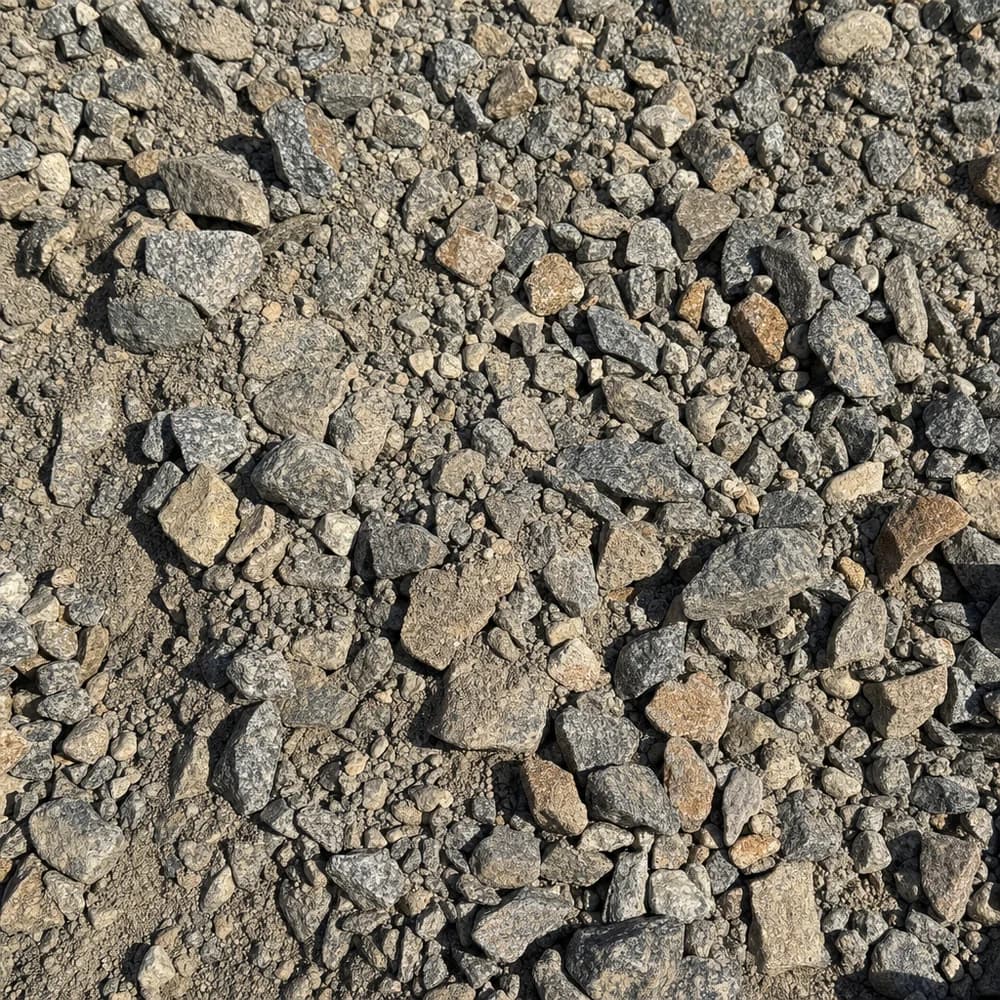
Class 6 Road Base carries a larger top stone, which is what lets it spread load across soft ground. That is the one for lanes, drives, yards and pads.
Crusher Run is the finer of the two and screeds smoother, which suits close grading and the base under a paver build. It is sized on the crusher run calculator. Crusher Fines, sold on the stone screenings page and known locally as squeegee when it is used as bedding, is a third material again and is a path surface rather than a structural base.
Ordering to the nearest load instead of the nearest ton
The ten percent tick box covers spillage and the settling of ordinary handling. It is not a compaction allowance for a fully engineered build, and on clay it is not much of a margin at all.
Round up beyond it in three situations: where the subgrade is soft enough that the first inch disappears into it, where the lane has a dip you have been meaning to lift, and where the calculated figure lands just over a round number. Being a ton short on a lane means the last stretch gets spread thin, and the thin stretch is the one that ruts first.
Take your tonnage to the Class 6 Road Base product page, set a quantity and a date there, then think about where it lands. Delivery is arranged at checkout by ZIP code and the driver needs firm, clear ground to tip on. On a long lane, walk the route beforehand and pick a spot the material can be pushed from in both directions, because moving seventy tons any further than necessary is the part of this job that takes the time.
Common questions
Will clay still damp from snowmelt take part of the first lift?
The arithmetic is exact for the rectangle you describe. What varies is underneath it. Firm, drained subgrade takes close to the calculated figure. Clay that is still damp from snowmelt will absorb part of the first lift before the grade starts rising, so treat the number as the floor on soft ground and order the next step up.
Class 6 or Crusher Run: which page does a lane tonnage belong on?
Class 6 Road Base for a lane, a drive, a pad or a yard. Crusher Run if what you are building is a paver base or anything you need to screed flat. If the surface course is going on top of the base as a separate order, that is driveway gravel or a clean stone, sized separately on the gravel calculator.
Where should seventy tons be dropped on an acreage lot?
Somewhere firm, reachable, and central to the run rather than convenient to the gate. A pile at the entrance means every yard of the far end gets carried the full length of the lane. Walk the access first, and remember that ground which carried a loaded truck in September may not carry one during a spring thaw.
Why does the panel show both a ton figure and a cubic yard figure?
Because you build in one and buy in the other. Lifts, spreading and the size of the heap are all volume, so yards is what you plan with. Base is sold by weight, so tons is what you order. The link between them is the published 1.50 tons per cubic yard, and if you are converting a figure from somewhere else that is the multiplier to use.
Is the six inches the thickness after the roller, or what I spread to get there?
Compacted. Enter the thickness you want after rolling and spread the material thicker than that to get there. Base drops as it is compacted, which is why it is worth checking depth with a probe part way through a lift rather than trusting the look of it, and why a lane spread to look right loose ends up shallow once traffic has been over it.
Related calculators
Thirty tons. Zero delivery fees.
Road base priced per ton, hauled free, at lane quantities where hauling usually costs the most.