Walkway Gravel: Building a Path That Survives Mud Season
For a mountain walkway facing spring melt, Walkway Gravel gives Colorado gardens a clean path surface that lets water move through.
- Size: 3/8 inch
- Grading: Graded mix of stone sizes
- Type: Crushed stone
From $407 for 1 ton, delivery included
Larger loads cost less per ton: 500 tons is $29,460 ($58.92 per ton). Pick any quantity below for a delivered price.
Free delivery included
Free delivery anywhere in Colorado
Pick a delivery date
Weekday delivery, earliest Oct 20
Get a Free Quote
Fill out the form and our sales team will get back to you within the hour.
Size and Grading
- Size
- 3/8 inch
- Grading
- Graded mix of stone sizes
- Type
- Crushed stone
The worn strip down the side of the house is the piece of ground that shows what Colorado weather does. Snow piles there all winter, a warm week in March melts it into clay that will not take the water, and the route to the trash cans turns to soup for a month. Walkway Gravel is a 3/8 inch crushed stone laid to give that route a surface water can get through, and whether it lasts more than a season comes down almost entirely to what goes underneath it.
The side-yard strip that turns to soup every March
A path fails for one of two reasons. Either water has nowhere to go, so the surface stays saturated and the stone gets pushed down into the mud, or the stone is sitting straight on soil and the two have mixed together until there is no path left, only a gravelly patch of ground.
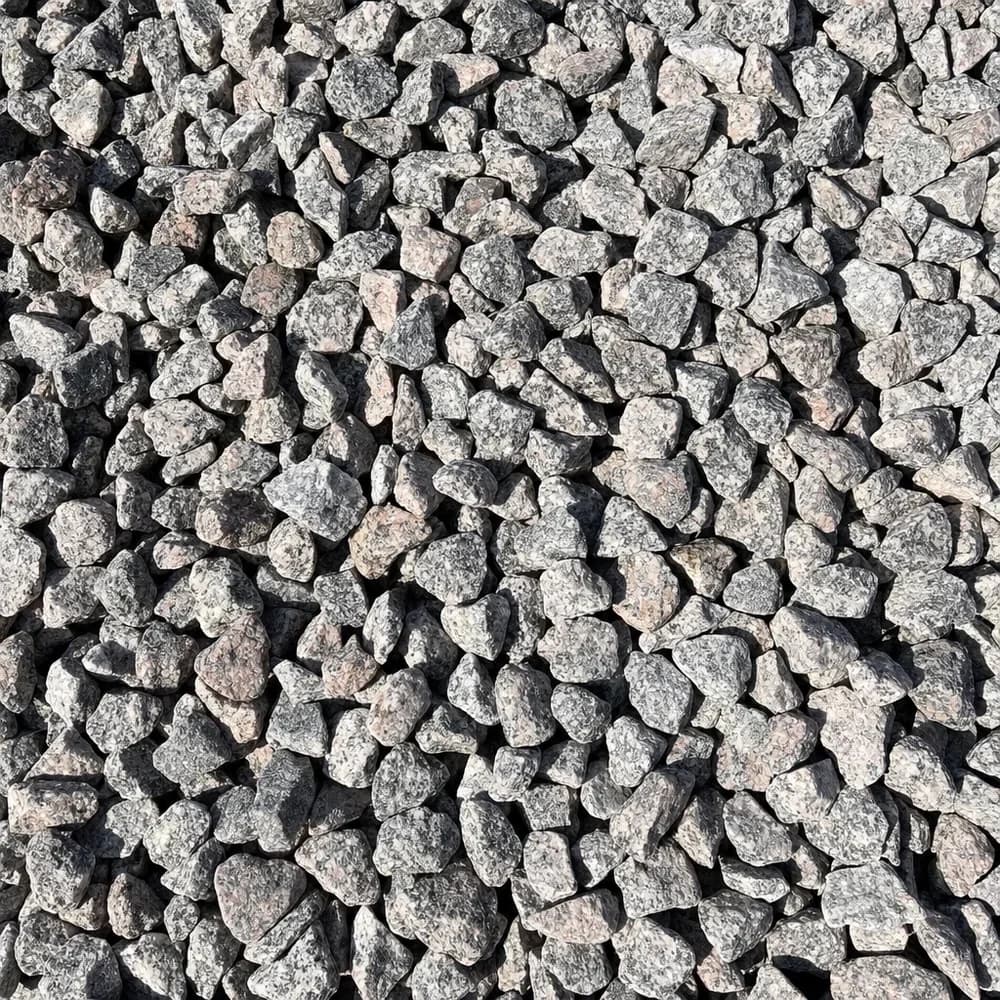
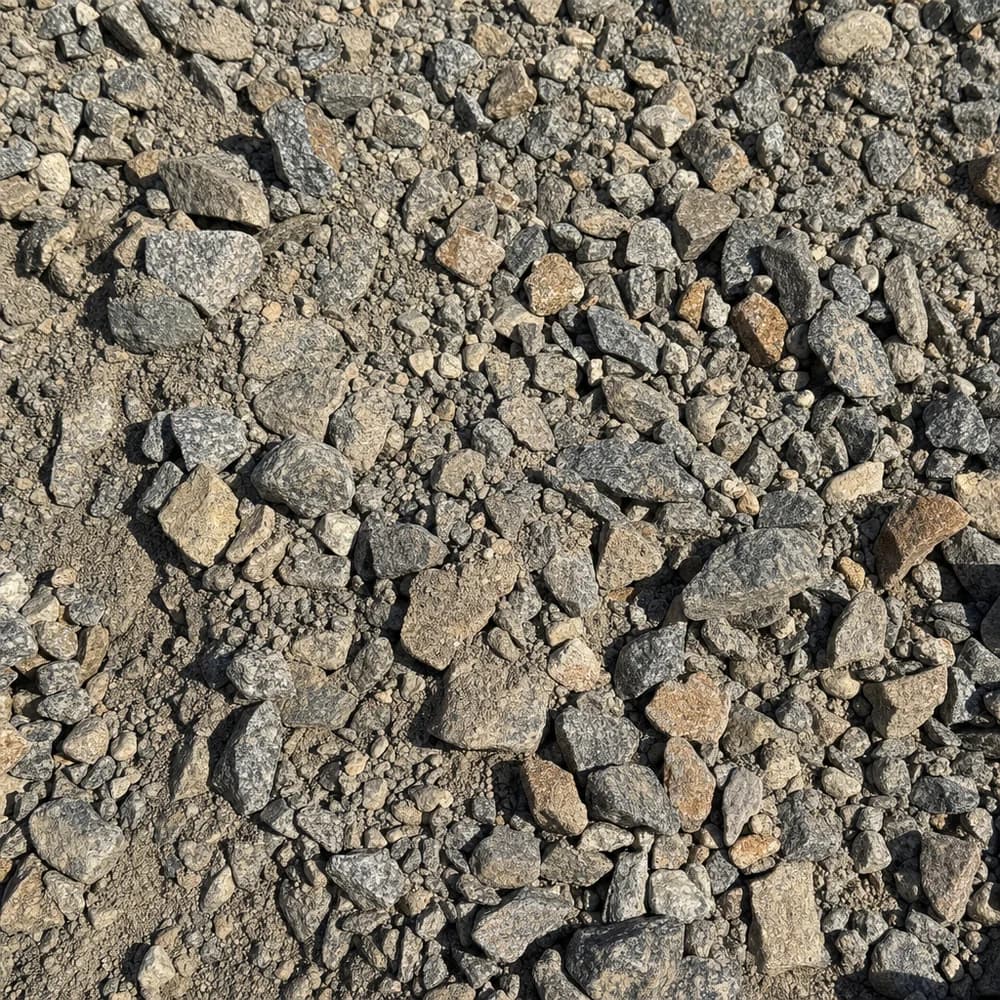
Crushed 3/8 inch stone solves the first problem by being open enough for water to pass straight through. It is a graded mix of stone sizes rather than a single size, so the smaller pieces fill between the larger ones and the surface stays firm underfoot instead of shifting with every step. The angular faces are what stop it scattering the way rounded stone does.
The second problem is not the stone's to solve. That one is a construction question.
What 3/8 inch crushed stone does on clay that will not drain
On free-draining ground, path gravel laid straight on the soil can last for years. On expansive Front Range clay it will not, for two reasons.
The first is that clay holds water against the bottom of the layer. Water that has drained through the stone sits there, and in a state that can run several freeze-thaw cycles in one week at altitude, that water freezes and lifts, thaws and drops, and does it again next week. A path over clay heaves unevenly through winter and needs raking level in spring.
The second is migration. Without a barrier, clay works up into the stone from below and stone presses down into the clay from above, and within a couple of wet seasons the two have merged. This is the single most common reason a gravel path stops looking like a path.
Fabric, edging and the lift that sits under the stone
- Excavate the route to the full depth of the finished build rather than piling stone on top of existing grade, so the path sits level with the ground beside it and water can leave across the edge.
- Shape the bottom to fall. Even a slight crown or cross-fall keeps water moving instead of collecting under the middle of the walk.
- Lay geotextile fabric across the excavation. It is what keeps the clay and the stone apart, and on clay it does more for the path than any amount of extra gravel.
- Compact a base lift of about 3 inches of Class 6 Road Base for a path that takes daily traffic or a wheelbarrow. A light garden path can go straight onto fabric.
- Set edging on both sides, standing slightly proud of the finished stone. Steel, timber or a row of set stone all work, and without something the path widens a few inches every year.
- Finish with 2 to 3 inches of the 3/8 inch stone, raked level and tamped lightly rather than compacted hard.
Splash pads, wall backfill and a pond edge: three jobs it will not hold
A downspout splash area. The flow off a roof in a summer storm is concentrated enough to scatter small stone and dig a hole in what is left. A hypothetical splash pad 4 by 5 feet at 3 inches is 20 sq ft, 20 x 3 / 12 = 5 cubic feet, or 5 / 27 = 0.19 cubic yards, and it wants River Rock on fabric.
Retaining wall backfill. Backfill behind a wall has to keep draining under pressure with soil pushing against it, and fine graded material packs shut. A drainage zone 20 feet long, 1 foot wide and 3 feet high is 60 cubic feet, or 2.2 cubic yards of washed #57 Stone with no fines in it.
A pond or shoreline edge. Water lapping at a bank moves 3/8 inch stone the first season. Bank work wants stone heavy enough to stay put, which is RipRap.
Raking Walkway Gravel back after a winter of shoveling
A gravel path needs about an hour of attention a year, most of it in spring.
Snow removal is the main thing that moves it. Shovel with a plastic blade held slightly above the surface rather than scraping, and throw the snow to the same side each time so the stone that does travel ends up in one place. A path that is edged will keep nearly all of it within the run.
In spring, rake the surface back level, pull the stone out of the low spots that freeze-thaw created, and top up anywhere the fabric is starting to show. A path built over a compacted base and fabric usually wants nothing more than a wheelbarrow of fresh stone every few years.
Tonnage for an L-shaped walk that widens at the gate
Paths are rarely rectangles, so break the route into straight sections that do not overlap and add them up. A hypothetical L-shaped walk: a 3 by 18 foot run, a 3 by 22 foot run and a 4 by 12 foot landing by the gate.
- Area: 54 + 66 + 48 = 168 sq ft.
- Volume at 3 inches: 168 x 3 / 12 = 42 cubic feet.
- Yards: 42 / 27 = 1.56 cubic yards.
- Tons: 1.56 x 1.40 = 2.2 tons, or 2.3 tons with the 5 percent the gravel calculator adds by default.
A straight 3 by 60 foot path at the same depth is 180 sq ft, 45 cubic feet, 1.67 cubic yards and 2.3 tons of surface stone, plus 1.67 cubic yards of base at 1.50 tons per cubic yard, which is 2.5 tons of Class 6. Order the two separately. The gravel calculator takes up to five areas at once and handles circles, which covers most curved routes.
Pick a quantity and a delivery date on this page. Delivery is arranged at checkout by ZIP code and the truck needs clear access to a firm dump spot, which on a narrow side yard usually means the driveway and a tarp. Colorado Rock Supply will answer build questions through the contact page.
Quickly Calculate How Much You Need
Material: Walkway Gravel
How to Measure
Measure the length and width of your project area in feet
Decide on depth in inches (2" for landscaping, 4" for driveways)
Enter the values above and we'll calculate the tonnage you need
Need help figuring out the right amount? We can help!
Call or text us at (719) 781-8522 and we'll help you calculate the right quantity for your project.
Not sure how much you need? The Gravel Calculator has depth guides, coverage charts and worked examples for this material.
Frequently Asked Questions About Walkway Gravel
Walkway Gravel delivery across Colorado
- Denver
- Colorado Springs
- Aurora
- Fort Collins
- Thornton
- Arvada
- Westminster
- Greeley
- Pueblo
- Boulder
- Longmont
- Castle Rock