Large River Rock: Cobble Sized to Stay Where the Water Runs
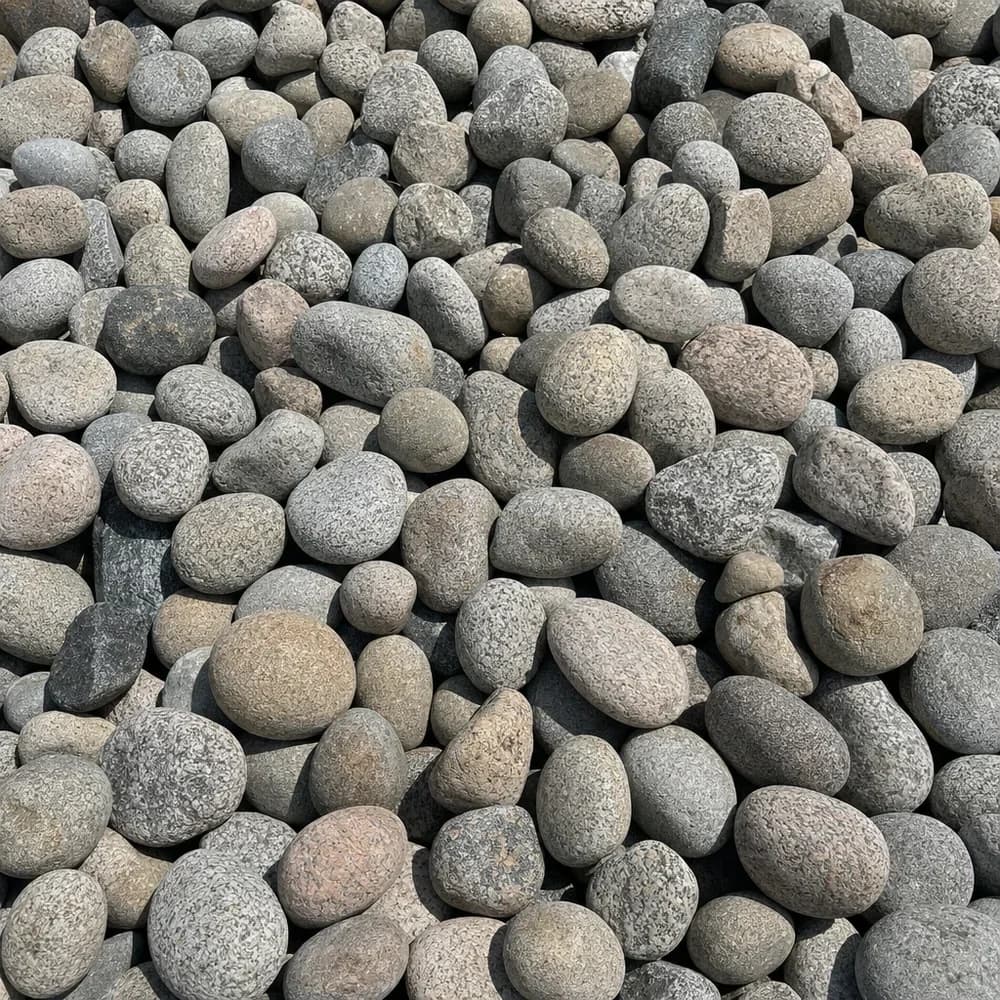
After Colorado freeze-thaw seasons, Large River Rock gives dry creek beds and water-feature edges a grounded, natural look that holds its place.
- Size: 2 inches to 4 inches
- Type: Smooth, naturally rounded stones
- Color: Tans, grays and browns
From $1,110 for 1 ton, delivery included
Larger loads cost less per ton: 500 tons is $97,270 ($194.54 per ton). Pick any quantity below for a delivered price.
Free delivery included
Free delivery anywhere in Colorado
Pick a delivery date
Weekday delivery, earliest Oct 20
Get a Free Quote
Fill out the form and our sales team will get back to you within the hour.
Size and Grading
- Size
- 2 inches to 4 inches
- Type
- Smooth, naturally rounded stones
- Color
- Tans, grays and browns
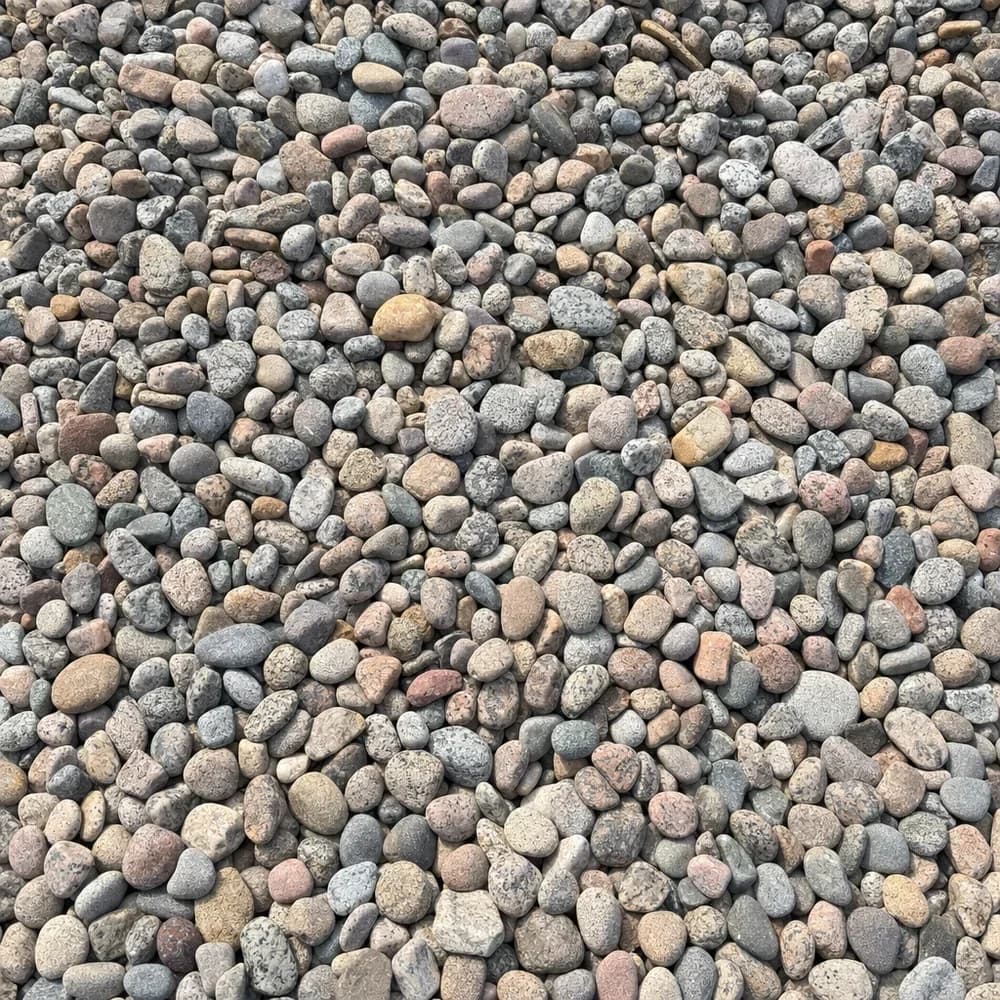
The choice in front of most people looking at this page is between two sizes of the same rounded stone, and it is usually settled by one question: does anything actually move through the spot in a storm? Large River Rock is cobble at 2 to 4 inches, smooth and water-rounded, in tans, grays and browns. Smaller rounded stone looks similar in a photograph and behaves completely differently once a monsoon-season downpour comes off the foothills.
Two to four inches, tumbled smooth, in tans, grays and browns
Individual stones are a comfortable handful, heavy enough that you set them rather than rake them. The color range is natural rather than uniform, so a bed of it never reads as a manufactured product, and the surfaces are worn smooth with no sharp faces.
At this size a single layer of stone is a visible feature rather than a texture. That is the practical difference from every smaller material in the catalogue: you see individual stones, their shapes and their shadows, which is why cobble ends up in the places a design wants the eye to land.
Where large river rock holds a line that smaller stone leaves behind
Runoff sorts stone by size. In a swale or a defined channel that carries water after snowmelt or a hard summer storm, 1 inch material migrates to the low end over a few seasons and cobble stays where it was placed. The weight is the whole mechanism, and it works in three settings.
A dry creek line that is doing a job. Not a decorative squiggle across the lawn but the route water already takes, given a channel, a bed of stone and banks that slow the flow.
A slope or swale edge. Where runoff concentrates and scours a little deeper each spring, cobble breaks the velocity before it undercuts anything.
A xeric bed that needs a focal point. Around a boulder, at a bed entrance, or as a band through finer material, where a couple of tons of cobble does more for a planting scheme than another pallet of shrubs.
Three jobs where it will make the problem worse
An RV or boat parking pad. Rounded 3 inch stone rolls under a tire and never compacts, so a heavy vehicle sinks through it and the pad ends up rutted and scattered. That build wants compacted Class 6 Road Base with an angular surface course over it.
A long rural lane. Same problem, several hundred feet of it, plus stone thrown into the ditch every time a truck accelerates. Lanes want Driveway Gravel over a compacted base.
A garden path. Walking on cobble is genuinely unpleasant, and it is worse for anyone with a stick, a walker or a wheelbarrow. Paths want Walkway Gravel or Crusher Fines.
One stone deep, two stones deep, and what depth means with cobble
With 2 to 4 inch stone, a 4 inch layer is a single course. That is the right depth for a decorative bed or a shallow channel, where the fabric underneath should not show through and the stones can nest against each other.
Where water runs, go to 5 or 6 inches so the stones are set two deep at the center of the channel, and bring the sides up the bank rather than stopping at the flat. Depth here is measured as placed, not compacted, because nothing about this material compacts.
Where flow is fast and concentrated, at a culvert outlet or in a ditch that already scours, cobble is not the end of the line. That is RipRap territory.
Two tons for a 30-foot creek line, laid by hand
Hypothetical figures using this site's published weight for river rock, about 2,700 lb per cubic yard or 1.35 tons per cubic yard. That figure is published for 1 to 3 inch stone, so treat it as approximate for cobble, which packs a little more loosely. Checked twice.
Dry creek line, 30 ft long, averaging 4 ft wide, 4 inches deep. 120 square feet. 120 x 4 / 12 = 40 cubic feet. 40 / 27 = 1.48 cubic yards. At 1.35, that is 2.0 tons.
Swale edge, 40 ft long, 3 ft wide, 5 inches deep. 120 square feet. 120 x 5 / 12 = 50 cubic feet. 50 / 27 = 1.85 cubic yards, or 2.5 tons.
Channels are rarely a neat rectangle, so measure width at several points and average it, or enter the sections separately in the river rock calculator, which takes up to five areas at once.
Placing it: gloves, a wheelbarrow, and a rake that will not help you
Cobble is set, not spread. A rake pushes it into ridges and a shovel mostly pushes it around, so plan on lifting stone with your hands and a wheelbarrow, and on a slower day than a load of gravel would be. A ton is a couple of hours for most people, which is worth knowing before ordering six.
Prepare first: shape the channel, lay geotextile fabric, then set the larger stones along the center line and fill around them. Ask for the pile to land at the top of any slope you are working, because moving cobble uphill is the part people regret. Delivery is arranged at checkout by ZIP code and the truck needs clear access to a tipping spot, so pick the drop point before you choose a date. If you are undecided between the two stone sizes, browse both in the full product list first.
Quickly Calculate How Much You Need
Material: Large River Rock
How to Measure
Measure the length and width of your project area in feet
Decide on depth in inches (2" for landscaping, 4" for driveways)
Enter the values above and we'll calculate the tonnage you need
Need help figuring out the right amount? We can help!
Call or text us at (719) 781-8522 and we'll help you calculate the right quantity for your project.
Not sure how much you need? The River Rock Calculator has depth guides, coverage charts and worked examples for this material.
Frequently Asked Questions About Large River Rock
Large River Rock delivery across Colorado
- Denver
- Colorado Springs
- Aurora
- Fort Collins
- Thornton
- Arvada
- Westminster
- Greeley
- Pueblo
- Boulder
- Longmont
- Castle Rock