River Rock Calculator for Borders, Beds and Dry Creek Runs
Enter your project dimensions
Rock beds get built in the weeks after the ground dries out and before the afternoon storms start arriving, which on most lots is a narrow stretch of late spring and early summer. That timing is not about the rock, it is about being able to see what the water did. Where snowmelt cut a channel across the yard and where a downspout threw grit onto the lawn are visible in April and gone by July. This river rock calculator turns whatever you mark out in that window into cubic yards and tons, and the first thing worth knowing is that two jobs of the same length can be very different orders.
Sixty feet of border and sixty feet of creek bed are not one order
Both of these are hypothetical, and both run sixty feet.
The first is a foundation border three feet wide, finished with three inches of one to three inch river rock. That is 180 square feet, so 180 multiplied by 3 and divided by 12 gives 45 cubic feet. Divided by 27 that is 1.67 cubic yards. River rock is published on this site at roughly 2,700 lb to the cubic yard, which the tool reads as 1.35 tons per yard, so the border comes to 2.25 tons, or 2.36 with the five percent ticked.
The second is a dry creek bed down the same side of the property, averaging four feet wide and laid five inches deep in cobble. That is 240 square feet and 100 cubic feet, which is 3.7 cubic yards and 5 tons, or 5.25 with the allowance.
Same length, a third more width, and more than double the weight on the truck. Almost all of that difference is depth, and depth is not a style choice.
Depth follows the stone size, not the look you are after
Rounded stone has to be laid deep enough to hide what is under it, and bigger stone needs more depth to do that. A useful rule is roughly twice the diameter of the stone: two inches for three-quarter to one inch rock, three to four inches for one to three inch rock, and four to five inches for anything larger.
Go thinner than that and the fabric grins through between the stones, which reads as a shortage of rock when it is actually a shortage of depth. Around here there is a second reason to hold the depth. Ground that swells when it is wet and shrinks back as it dries works stone downward over a few seasons, and a thin bed disappears into it faster than a deep one.
Splitting a curved border into shapes the river rock calculator accepts
The tool takes a rectangle, a circle, or up to five areas totaled together, with feet for length, width and diameter and inches for depth, anywhere from 0.25 to 24.
Curves are the normal case in a bed and there is no curve option, so approximate. Run a tape down the middle of the bed for length rather than around the outside edge, then measure the width at four or five points and average them. A bed that bulges round a shrub and narrows at the path is better entered as two rectangles than as one with an optimistic average.
Circles want a diameter. A ring around a tree is the outer circle less the inner one, worked out on paper and entered as a rectangle of the same area, since the tool has nothing to subtract with.
Once the shapes are in, pick the material so the correct weight applies, then decide on "Add 5% extra for compaction & spillage". It is optional, and it stays ticked until you untick it.
Why a ton of cobble looks smaller tipped than it did on the screen
The panel returns cubic yards, tons and cubic feet, and with decorative rock the gap between the first two is what surprises people.
At 1.35 tons per cubic yard, one ton is about three-quarters of a yard. Tipped out it is a low, spreading cone rather than the mountain people picture, and next to a sixty-foot bed it looks like nothing at all. Nothing has gone wrong. Cubic yards is the figure that tells you how far it spreads; tons is only what it weighs.
Cubic feet is the raw volume and the number to check the arithmetic against if the result looks off. The quickest sanity check in the yard: a cubic yard of rock covers about 108 square feet at three inches, and roughly half of that at six.
The front edge, the low corner, and the extra that goes into them
The five percent option covers spillage and the stone that packs down as you rake it. It is worth ticking on any rock job, but it is not what saves you.
What saves you is ordering the next quarter ton up, because rounded stone always finds somewhere to go. The front edge of a bed, where people see it from the drive, wants to be built slightly proud. The low corner takes more than the average depth you entered. Downspout landing zones wear thin first and need topping. A quarter ton of rounded stone is not much to have left over and it sits perfectly well in a corner until you want it.
Under-ordering on decorative rock is worse than under-ordering on base, because the shortfall shows. A bed spread thin to reach the end is visible from the street for as long as it stays that way.
River rock, cobble or drain rock: what the water is doing decides
Three products cover most of this work and they are chosen by function, not by color.
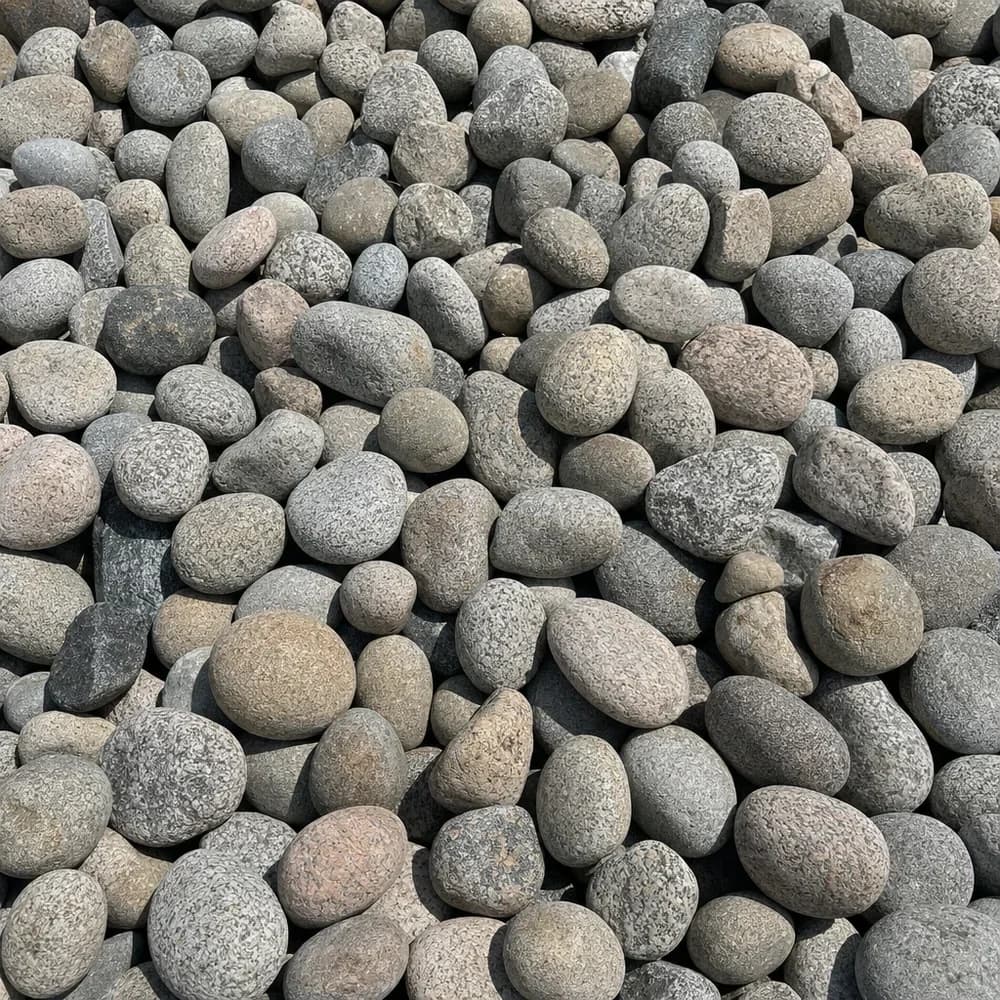
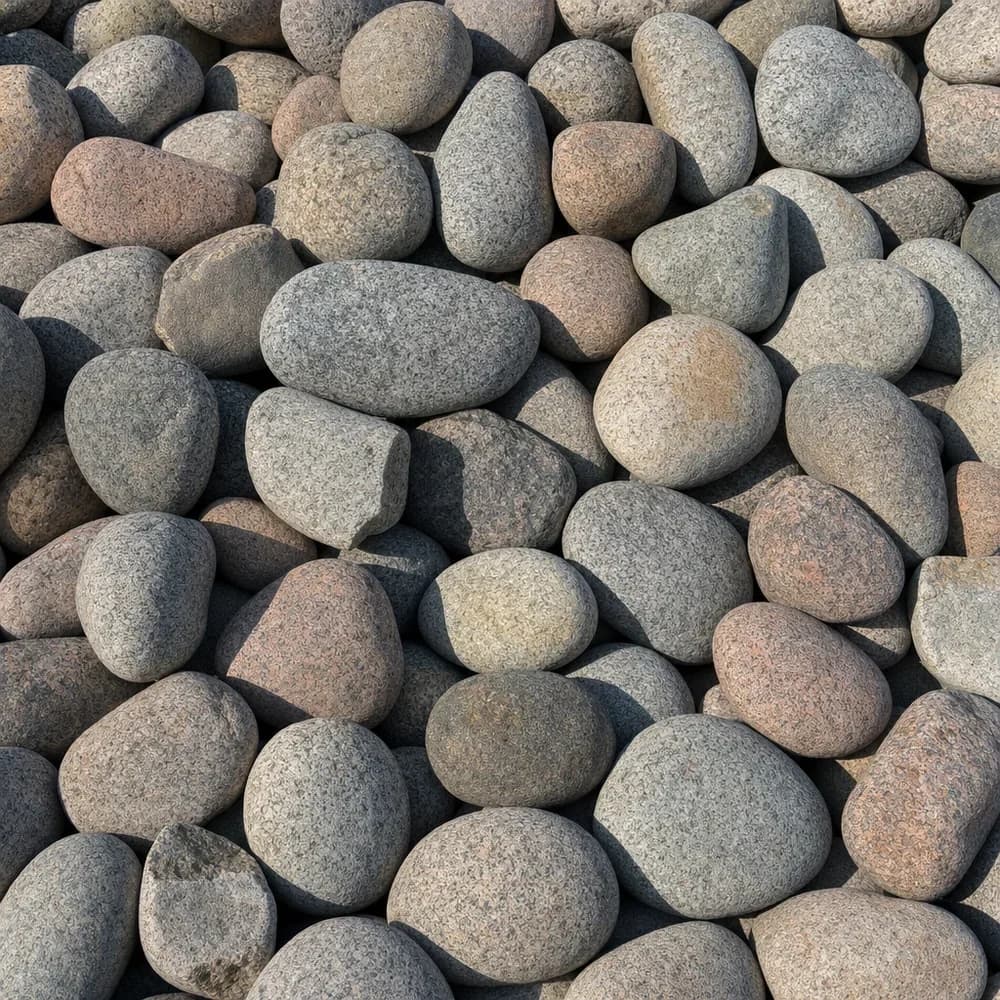
River Rock at one to three inches is the general decorative grade, for beds, borders and xeric ground cover. Large River Rock, which most people locally just call cobble, is the one for dry creek beds, swale bottoms and anywhere runoff needs slowing, because small stone simply travels when water moves over it. Where a channel needs stone that holds under moving water rather than a dressing over it, that is the rip rap calculator. Set the largest anchor stones a third into the ground so they look placed rather than tipped.
Drain Rock is the odd one out and it is not decorative. It goes where water is actually being carried, in French drains, drywells and downspout runs, and it is sized on the gravel calculator alongside the other angular grades. If the bed you are building is doing drainage work as well as looking like a creek, those are usually two materials and two calculations: clean stone in the channel, cobble over the top.
Fabric goes under any of them, pinned, with one exception. Where stone is part of a working drain, the fabric wraps the stone rather than sitting beneath it.
When the tonnage is settled, open the product page for the stone you chose, set a quantity and a date there, and check the drop spot first. Delivery is arranged at checkout by ZIP code, and the driver needs firm ground with clear access to tip on. Bark over the same measurements weighs a fraction of this, which the mulch calculator will show you.
Common questions
My bed curves around the corner of the house and nothing about it is square. How do I measure it?
Take the length along the center of the bed with a tape laid on the ground, then take the width in several places and average them. Where the bed changes character, for instance a three-foot border that opens into an eight-foot planting area, split it there and enter two areas instead of averaging across both. The tool totals up to five, which covers most front yards.
The rock bed I already have has thinned out. What do I enter?
Enter the depth you are adding, not the finished depth. Push a stick down to the fabric in a few spots, compare that with the depth you want, and use the difference. Clear the leaf litter out first, because a bed that measures two inches with three years of debris in it is shallower than it reads.
What happens if the order comes up a quarter ton short?
The last stretch of the bed gets raked thin to make it reach, and on rounded stone that is obvious from the moment it is done. It also tends to be the far end of a border, which is the part nobody wants to redo. Rounding up is cheap insurance on a material that keeps indefinitely in a corner of the yard.
How accurate is the figure for a bed that is not a neat shape?
The arithmetic is exact for the shapes you type in, so the accuracy comes down to how honestly you measured the widths. On an averaged curved bed, expect to be within about ten percent, and expect the error to run short rather than long, because people tend to average toward the narrow parts. Depth is where the real variation lives.
Which product page do I use once I have the tonnage?
River Rock for beds, borders and general ground cover. Large River Rock for dry creek beds, swales and slope work where the stone has to stay put. Drain Rock if the job is carrying water rather than decorating over it.
Related calculators
Rock beds are a one-time buy.
River rock, large river rock and drain rock by the ton, free delivery included.