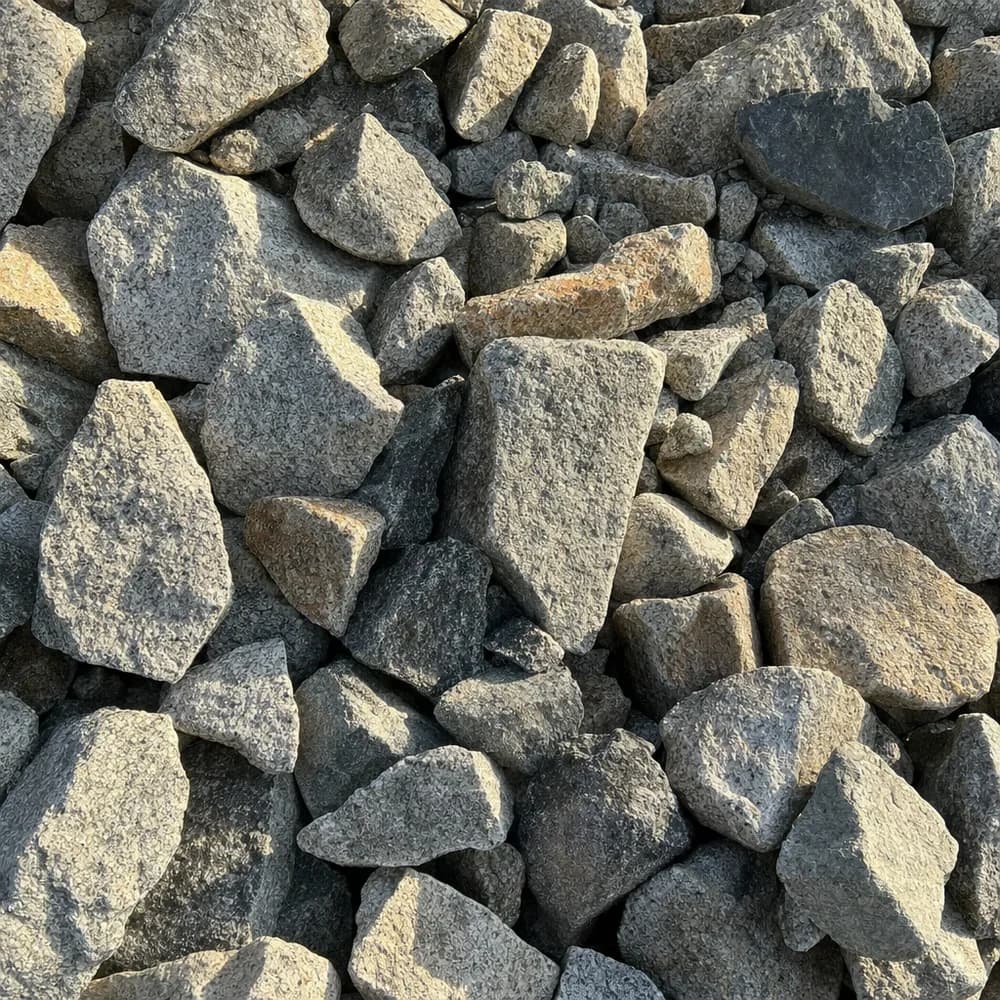
Rip Rap Calculator for Scoured Banks, Swales and Culvert Outlets
Enter your project dimensions
Walk out to the culvert after a hard August storm and the damage tells you what you need to know. A notch cut into the soil below the outlet, a fan of washed material spread twenty feet downstream, undercut sod hanging over the edge of a swale that ran full for forty minutes. That scour line is the measurement the rip rap calculator wants: how deep the water has already dug, how far back it has worked, and how much of the bank face is exposed.
The scour below the outlet is telling you the layer depth
Armor stone is not spread like landscape rock. It is placed in a layer thick enough that the water cannot pluck individual stones out of it, and the rule is one and a half to two times the largest stone dimension, with 12 inches as the practical floor for anything doing real erosion control.
| What you are protecting | Layer thickness |
|---|---|
| Pond bank, downspout outfall, slow stream | 12 inches |
| Standard 4 to 12 inch stone on a working swale | 12 to 18 inches |
| Faster channels, boat wake, larger stone | 24 inches |
Two local conditions push those figures up rather than down. Snowmelt runs a swale hard and steadily for weeks at a time in spring, and a monsoon-season thunderstorm dumps its water in twenty minutes with nothing to slow it. A channel that is dry ten months of the year can still be a 24 inch job. When you are caught between two sizes, take the bigger stone and the thicker layer.
Note that 24 inches is where the depth field stops. If a design calls for more than that, run the same footprint twice at half the thickness and add the results, or split it across entries in Multiple areas.
Tape the slope face, not the ground you are standing on
This is the mistake that owns this page. People pace the bank from above and enter the flat distance, which is always shorter than the face the stone has to cover.
Take an example. A bank 4 ft high cut at 2:1, which is the steepest face you should be armoring without an engineer, runs out 8 ft horizontally. The face itself measures about 8.9 ft down the slope. Over 60 ft of swale, the flat measurement gives 480 sq ft and the true face gives 534 sq ft. At a 12 inch layer:
- Flat measurement: 480 ÷ 27 = 17.78 cubic yards, or 27.6 tons
- Slope face: 534 ÷ 27 = 19.78 cubic yards, or 30.7 tons
Three tons short, on a job where the shortfall lands at the top of the bank, which is the part that unravels first. Run the tape down the face.
Shape the slope before you measure anything. Anything steeper than 2:1 needs engineering rather than more rock.
A culvert apron in the rip rap calculator, from the pipe outward
Hypothetical example. A 24 inch culvert under a ranch approach, with an apron running five pipe diameters downstream, so 10 ft long by 9 ft wide.
- Choose Rectangle.
- Length 10, Width 9, in feet. That is 90 sq ft.
- Depth 18, in inches.
- Select the material so 1.55 tons per cubic yard is applied.
- Tick Add 5% extra for compaction & spillage.
- Calculate.
- 90 x 18 ÷ 12 = 135 cubic feet
- 135 ÷ 27 = 5.00 cubic yards
- 5.00 x 1.55 = 7.75 tons
- With the 5% ticked: 5.25 cubic yards and 8.14 tons
Order about 8 tons of RipRap. Then size what goes underneath it, because armor stone laid straight onto soil settles as the bank erodes out from below. Either non-woven geotextile, which is not stocked here and comes from a landscape supplier, or 3 to 4 inches of #4 crushed stone as a bedding layer: the same 90 sq ft at 4 inches is 30 cubic feet, 1.11 cubic yards, about 1.61 tons at the 1.45 figure that stone carries.
Set the lowest course below the expected scour depth as well. Riprap comes apart from the bottom, and a buried toe is what stops that starting.
Find out what approval your state and local authorities require before stone goes in below the ordinary high water line of a creek, ditch or pond. Armoring in and along water is commonly permitted work, what is asked for changes from one waterbody to the next, and this page does not stand in for that conversation.
Thirty-one hundred pounds a yard, the heaviest thing on the list
RipRap is published on this site at approximately 3,100 lb per cubic yard, which is 1.55 tons, the heaviest material in the range. Combine that weight with a layer twelve inches thick or more and the coverage per ton drops away sharply compared with anything else you might order.
| Layer thickness | Approximate coverage per ton |
|---|---|
| 12 inches | 17 sq ft |
| 18 inches | 12 sq ft |
| 24 inches | 9 sq ft |
A ton of armor stone is roughly two thirds of a cubic yard. Stone up to about 6 to 8 inches can be set by hand; above that it wants a machine. The pile always looks too small for the bank until it goes down at full depth.
Swale banks, dry creek beds and the stone under the stone
- A swale that scours after snowmelt. Measure the wetted face on both sides plus the invert, shape to 2:1, then 12 to 18 inches of stone over fabric.
- A culvert or downspout outfall. Extend the apron four to six pipe diameters downstream. That is the reach where the water is still moving fast enough to dig.
- A pond or ditch bank. Bury the toe below the waterline, then work up the face with the top course placed so the stones bear on each other rather than sitting where they landed.
- A dry creek bed built to move water. Armor stone at the pinch points, with cobble through the wider sections where the water spreads and slows, sized on the river rock calculator.
- Behind a retaining wall. That is drainage rather than armor, and it wants clean drain rock rather than anything on this page.
Where five percent runs out on armor stone
The 5 percent option is sized for materials that compact and spill. Armor stone does neither, so on this one material treat it as a rounding nudge rather than a real allowance.
What actually needs allowing for is placement. Stones do not tessellate, the toe trench takes more than the calculated face area, and a bank is never as even as the rectangle you entered. Keep a small reserve pile on site rather than ordering to the exact figure, because after the first big storm you will be walking the line and putting a few stones back, and a second delivery for half a ton is a poor use of anyone's day.
Check the truck route before ordering. A loaded truck near a pond edge or down a soft swale bottom is how stone ends up being moved twice. Delivery is arranged at checkout by ZIP code, and the driver needs firm ground with clear access to tip on. If the layer depth is the part you are unsure about, ask through the contact page before the order goes in.
Common questions
The cubic yards match a #57 order, so why is the armor stone tonnage higher?
Because the weight per cubic yard is different for every material, and armor stone sits at the top of the range. This site publishes RipRap at about 3,100 lb per cubic yard against roughly 2,800 for #57 or 3/4 inch stone and 2,700 for river rock. Identical dimensions, identical cubic yards, and about ten percent more tonnage on the armor stone.
Does the 5 percent tick cover the toe trench and the stones that will not sit flat?
It is the smallest of your allowances here. It handles the odds and ends, not the toe trench, not the uneven face, and not the stones that will not sit where you want them. Tick it, then round the tonnage up on top of it and keep the leftovers by the bank for repairs.
On a 2:1 bank, does the tool want the flat distance or the face distance?
Run the tape down the face of the slope from the top of the armored section to the toe, rather than measuring the horizontal distance across it. Multiply that face measurement by the length along the channel or shoreline. On a 2:1 bank, face measurement runs about ten percent longer than the flat distance, and the gap widens as the bank steepens.
The outside of the bend wants a thicker layer than the inside. Can one entry handle both?
Split it at the corner and enter each leg separately using Multiple areas, which takes up to five. Keep the legs from overlapping at the corner or you will pay for that square twice. Different legs often want different layer thicknesses too, since the outside of a bend takes more force than the inside, and separate entries let you do that.
Does the buried toe trench count as area I have to order stone for?
Not in the way you would on a patio, because riprap does not get edged. What it does need is an anchored perimeter: the toe buried below scour depth at the bottom, and the top course carried above the high water line. Include that buried toe trench in your measurement, since it takes stone that never shows.
Related calculators
Banks don't armor themselves.
RipRap by the ton with free delivery, plus the #4 bedding stone to go under it.