Fill Dirt Calculator for Holes, Trenches and Low Corners
Enter your project dimensions
Every fill estimate on clay ground carries an error you cannot measure out of it. The hole you are filling has a bottom you cannot see, its sides are rarely square, and the clay under much of this state swells when it is wet and shrinks back when it dries. The dirt calculator gives you an exact volume for the shape you describe. What it cannot tell you is how much of that volume the ground will take back over the first year. Knowing where the estimate ends is most of the skill in ordering fill.
Where a measured hole and a delivered yard part company
Three things pull the real figure away from the calculated one.
Loose fill placed in a hole drops as it consolidates, most of it in the first few wet cycles. Sides that slope inward hold more than a rectangle of the same top dimensions. And a soft bottom, which is common in a trench that has stood open through a spring, takes the first load without raising the grade at all.
None of that is a reason to skip the arithmetic. It is a reason to treat the result as the floor rather than the answer, and to measure the deep end and the shallow edge separately rather than eyeballing an average.
Cubic yards, tons, and what a wet spring adds to the weight
Volume is what you are buying. Weight is what arrives on the truck. Fill dirt is published on this site at roughly 2,400 lb per cubic yard dry, which is 1.20 tons, and a yard soaked through can reach 3,000 lb, or 1.50 tons.
| Material | Weight per cubic yard | Tons per cubic yard |
|---|---|---|
| Fill dirt, dry | approx. 2,400 lb | 1.20 |
| Fill dirt, wet | up to 3,000 lb | 1.50 |
| Screened topsoil | approx. 2,200 lb | 1.10 |
| Garden soil, blended | approx. 2,000 lb | 1.00 |
Rain changes the weight, not the volume, so a wet forecast does not change how much you order. It changes how the material behaves in a wheelbarrow and whether it compacts or smears.
Putting a settled trench line into the dirt calculator
Hypothetical example. A water service was run across a pasture two summers ago and the line over it has sunk. The soft strip is roughly 40 ft long and 3 ft wide, and a string line across it reads about 14 inches down at the worst point.
- Choose Rectangle as the shape.
- Length 40, Width 3, in feet. That gives 120 sq ft.
- Depth 14, in inches. The field accepts 0.25 to 24.
- Select the material so the fill weight is applied.
- Leave Add 10% extra for compaction & spillage ticked.
- Calculate.
- 120 x 14 ÷ 12 = 140 cubic feet
- 140 ÷ 27 = 5.19 cubic yards
- 5.19 x 1.20 = 6.22 tons
- With the 10% ticked: 5.71 cubic yards and 6.84 tons
Order about 6 cubic yards, place it in 6 to 8 inch lifts, and soak or compact each lift before the next one goes on.
That 24-inch ceiling on the depth box is worth knowing before you start. A post hole or an old cistern 3 ft deep will not go in as one entry. Split it into two entries in Multiple areas mode, or run the same footprint twice at half the depth and add the results.
Rule of thumb: for lawn repair, leave the finished surface about half an inch proud. It will settle flush.
Fill dirt, topsoil and garden soil each have their own tool
Four calculators on this site handle material that people all call dirt, and picking the wrong one puts the wrong weight on your order.
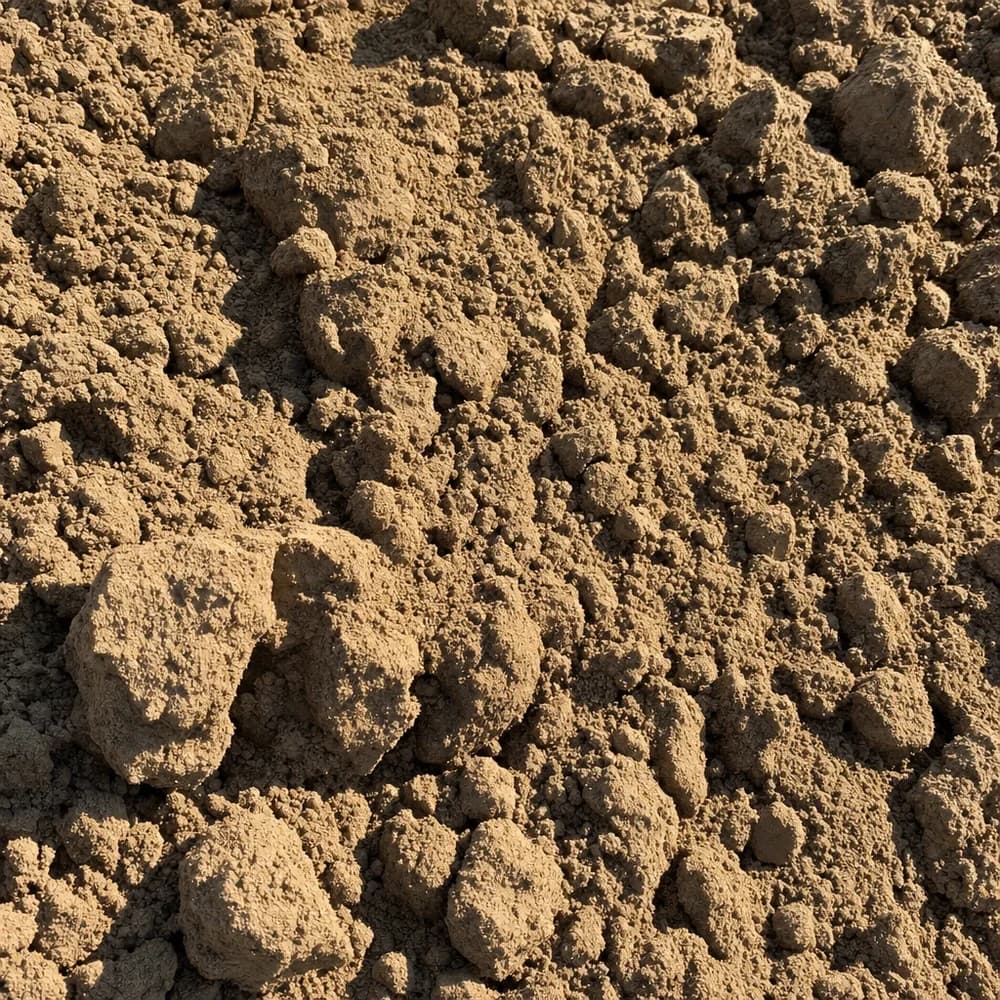
- This one sizes Fill Dirt, the screened subsoil that goes in below grade. Holes, trenches, berms, and raising a grade before base stone goes down. It is a structural material, not a growing one.
- The topsoil calculator sizes the top 4 to 6 inches under seed or sod. In the alkaline, low-organic soils common here, that upper layer is the one that gets amended.
- The soil calculator covers garden soil in raised beds and planters.
- The gravel calculator takes over the moment the layer you are sizing is rock rather than soil.
A regrade that will be seeded is normally two orders: fill dirt up to within 4 to 6 inches of finished grade, then screened topsoil over the top.
Four jobs an acreage regrade usually breaks into
- A sunken corner of lawn. Measure the deep point and the shallow edge, take the midpoint, and fill in one lift if it is under 4 inches.
- A utility trench. Length by width by the open depth. Compact in lifts, because a trench that is only tipped full will show as a line in the grass within a season.
- A windbreak berm. Hypothetical: 22 ft long, 5 ft wide, 12 inches at the crown. A berm is a triangle in cross section, so the average across the footprint is about 6 inches. 110 sq ft x 0.5 ft = 55 cubic feet, which is 2.04 cubic yards, or 2.44 tons. Berms settle harder than flat fill because nothing confines the sides.
- Bringing grade up before a drive goes in. Fill first, compact it properly, and only then run the stone tonnage. Base laid over loose fill fails from underneath.
Keep wood, roots and construction debris out of anything you backfill. Buried organic material rots away and leaves a hollow that shows up years later as a dip in the grass.
Ordering for the settlement rather than for the hole
The 10% option covers spillage and the material that packs down under a tamper. It does not cover a hole with sloped sides, a soft bottom, or the drop you get through a first freeze and thaw. On anything deeper than about a foot, round the calculated yardage up on top of that.
Fill is also the least troublesome thing on a job site to have a surplus of, and the most annoying to be short of, because being short means the finish work waits. When the result lands between two figures, take the higher one and use the remainder to top up the lifts as they consolidate.
Take your yardage to the Fill Dirt product page to set a quantity and a date. Delivery is booked at checkout against your ZIP code, and the driver needs a firm, reachable spot to tip on, which on a wet spring day rules out most of a pasture.
Common questions
What happens if I order too little?
The job stops at the point where finish work should start. The lift you were compacting is left part-filled, the surface cannot be graded, and a rain on an open trench means digging out mud before you can carry on. Under-ordering costs more time than over-ordering costs material, which is why the advice on this page always rounds up.
How accurate is the number for a hole that is not a neat rectangle?
The arithmetic is exact for the shape you describe. Real holes have sloping sides and soft bottoms, so they generally take more than the calculated volume, not less. Measure the widest points for the footprint, take the midpoint of the deepest and shallowest readings for the depth as above, and treat the figure as a minimum rather than a target.
Which product page do I go to once I have the yardage?
Fill Dirt for everything below grade. If part of the same job will be seeded or sodded, Top Soil for the upper 4 to 6 inches, calculated separately. Garden Soil only if it is going into a bed or planter.
Where should the load go on an acreage lot?
On firm ground within wheelbarrow range of the work, and not on the grass you are about to repair, because a fill pile kills what is under it within a few days. Check the route in before you order. Ground that carried a truck in the fall may not hold one during snowmelt.
Why does it give me both a ton figure and a cubic yard figure?
Fill dirt is planned in yards, because depth, lifts and the size of the pile are all volume. Tons come from the published weight, 1.20 tons per cubic yard dry, and tell you what the truck is carrying. The same yardage weighs noticeably more after rain, but you do not order any less of it.
Related calculators
Cheap by the yard, free to your gate.
Screened fill dirt for grading and backfill, delivered across Colorado.