Crusher Run Calculator for Pads, Paths and Patio Bases
Enter your project dimensions
Base work here has a season, and it is shorter than the calendar suggests. Frozen ground will not compact, snowpack at altitude keeps a subgrade wet well into spring, and a plate compactor on saturated clay just pumps it up and down. So most pads get measured early and built between late spring and the first hard freeze. The crusher run calculator is the part you can finish at the kitchen table in March, months before anything is dug.
Measuring in March for a pad you will build in June
Crusher run is ordered by the finished, rolled depth. It sits looser in the truck than it will once a plate has been over it twice, so a figure taken off a loose lift comes up short every time.
Take the measurements in feet. For a pad, length by width at the outside edge of the stone, not the outside edge of the shed. The base should run past the structure a few inches so the edge has something to lean on. For a path, tape the centerline and the widest point, then treat it as a rectangle.
Then settle the compacted depth before you open the tool:
- 4 inches under paths and under pavers
- 4 to 6 inches under a car
- 6 to 8 inches where a truck or a loaded trailer will sit
On the expansive clay that runs through much of the Front Range, take the top figure in whichever range applies and lay woven fabric under the stone, which is a landscape-supplier item rather than anything in this catalogue. Clay moves with moisture, and stone with nothing between it and the subgrade works its way down into it over a few wet seasons.
Running a 13 by 14 shed pad through the crusher run calculator
Hypothetical example. A 13 by 14 ft shed on ground that stays soft into May, so the pad gets 6 inches.
- Pick Rectangle. Circle and Multiple areas, up to five of them, are the other two options.
- Length 14, Width 13, both in feet. That is 182 sq ft.
- Depth 6, in inches. The box takes anything from 0.25 to 24.
- Choose the material so the right weight is applied.
- Leave Add 10% extra for compaction & spillage ticked.
- Press Calculate.
The arithmetic behind it:
- 182 x 6 ÷ 12 = 91 cubic feet
- 91 ÷ 27 = 3.37 cubic yards
- 3.37 x 1.50 = 5.06 tons
- With the 10% ticked: 3.71 cubic yards and 5.57 tons
Order 6 tons and put it down in two 3-inch lifts, compacting each one. Results come back as cubic yards, tons and cubic feet together, and Email my quote sends the set of numbers to your inbox so you are not retyping them at the product page.
Rule of thumb: two 3-inch lifts outlast one 6-inch lift, every time.
Fines in the voids: where the extra weight per yard comes from
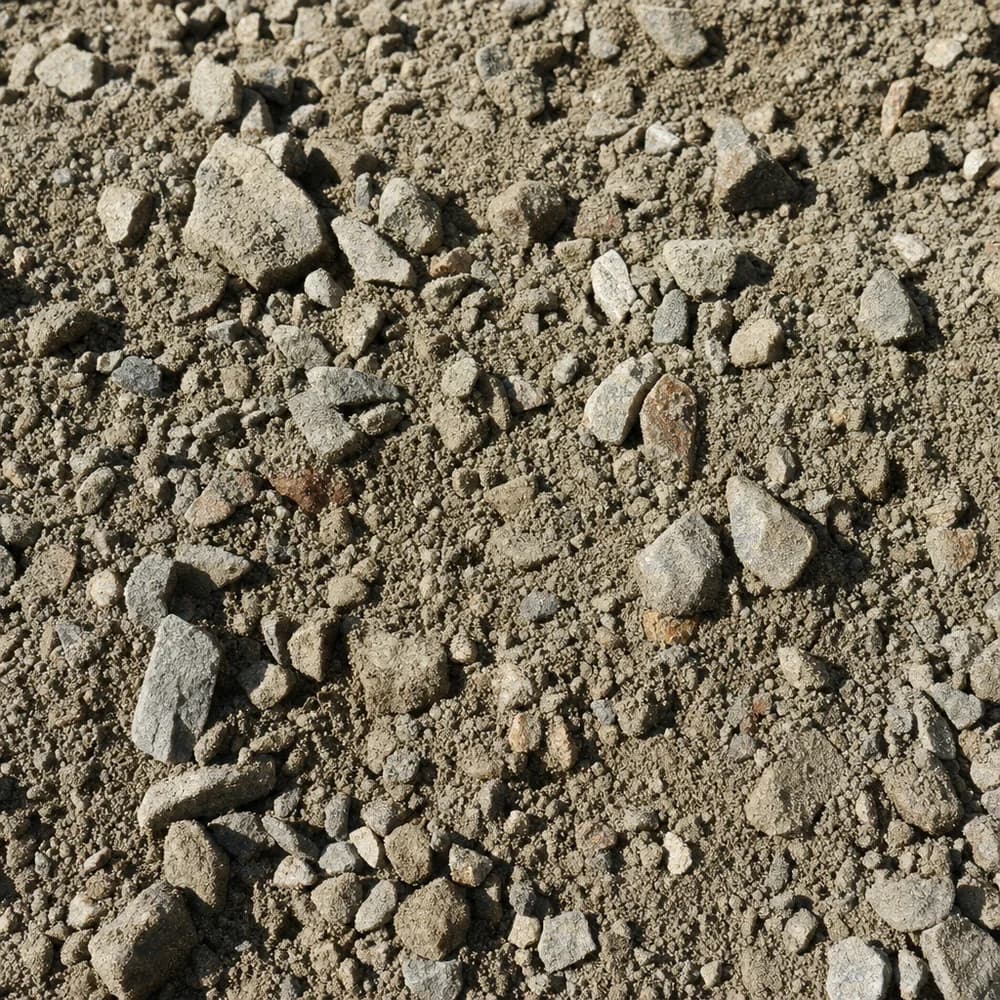
Fines are the difference. Clean washed stone has open voids running right through it. Crusher run has dust and small chips packed into those voids, which is what lets it lock up under a compactor, and it is also why the same hole takes more weight. These are the published figures on this site:
| Material | Weight per cubic yard | Tons per cubic yard | Tons per 100 sq ft at 4 in |
|---|---|---|---|
| Crusher run | approx. 3,000 lb | 1.50 | 1.85 |
| Crusher Fines | approx. 2,900 lb | 1.45 | 1.79 |
| 3/4 inch crushed stone, #57 | approx. 2,800 lb | 1.40 | 1.73 |
Cubic yards never change between those rows. Only the tons do.
Crusher Run, Class 6 and Crusher Fines are three separate orders
They get muddled constantly, and ordering the wrong one is expensive to undo once it is spread.
- Crusher Run is the 3/4 inch minus base with the fines left in. Patio bases, shed and hot tub pads, short drives. It is what this tool sizes.
- Class 6 Road Base is the CDOT class most acreage drives and turnarounds get specified in. It has a tool of its own, the road base calculator.
- Crusher Fines is the 1/4 inch minus material, called squeegee around here when it is used as bedding. Trails, garden paths, dog runs, and bedding under pavers or pipe. It is not a base course under anything carrying a vehicle.
Depths for a hot tub pad, a garden path and a rural lane
- Hot tub or shed pad: 4 inches over stripped ground, 6 where the soil is soft.
- Under pavers: 4 inches compacted in 2-inch lifts. The full layer stack, bedding included, is sized in the paver base calculator.
- A rural lane with no surface course: crusher run alone packs into a drivable crust. It raises dust through a dry summer and wants regrading every few years. Two or three inches of driveway gravel over the top settles both complaints.
- A French drain: not this material. The fines that make it compact are the same fines that hold water. Use drain rock or a clean washed stone instead.
What to add before the plate compactor comes out
Leave the 10% option ticked on anything you intend to pack down. Then look at two more things.
The first is the subgrade. If it is clay still soft from snowmelt, round the dimensions up as well, because a soft spot swallows stone that a firm one would not. The second is the leftover. Base is the one material where landing between two ton figures should send you to the higher one. Whatever does not go into the pad patches the first pothole that shows up in the approach.
Take the ton figure to the product page to set a quantity and a delivery date. Delivery is arranged at checkout from your ZIP code, and the truck has to be able to reach a firm spot to tip on. If the depth is the part you are unsure about, ask through the contact page before you order.
Common questions
The pad sits on uneven clay. How far out can the tonnage be?
The arithmetic is exact. The site is not. An uneven subgrade, a slope, and how hard you compact all move it, usually within about a tenth either way. Measure the deepest part of the footprint as well as the average, and use the deeper number if a second delivery would hold up the job.
I have my tonnage. Which product page do I order from?
The one that matches what you selected in the material box. A patio or shed pad base goes to Crusher Run. A drive or turnaround specified as Class 6 goes to Class 6 Road Base. A path surface goes to Crusher Fines. Quantity and date are set on the product page, not here.
Which spot behind the house will still take a loaded truck in April?
A firm, level spot on the working side of the pad, close enough to wheelbarrow from but clear of where the base is going. A pile sitting on the footprint has to be moved twice. Check the truck can get there without crossing soft ground or a swale, and remember that ground which carried a truck in September may not carry one in April.
Crusher run is sold by the ton, so what is the cubic yard figure for?
Crusher run is handled by the ton, so that is the figure you order against. Cubic yards are there because depth guidance, coverage and the size of the pile all work in volume. One number is for the order, the other is for planning where it goes.
Is the 6 inches I type the depth before the plate compactor or after it?
The compacted depth, the one you want when the job is finished. Loose material takes up more room than it will after rolling, so entering a loose lift leaves the finished base short. Specs are always written for the layer after compaction.
Related calculators
Base tonnage sorted? Good.
Crusher run by the ton, the cheapest structure on the yard, delivered free.