Class 6 Road Base in Colorado: How Deep to Go and How Much to Order
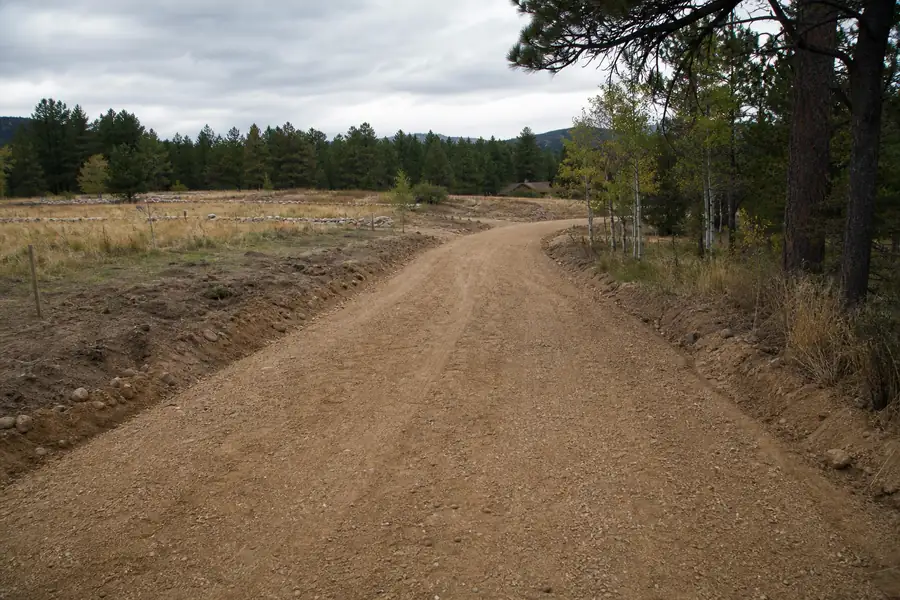
Quick answer: Most Colorado driveways need a 4 to 6 inch compacted layer of Class 6 Road Base, with mountain driveways and heavy-use pads running 6 to 8 inches to handle spring melt and frost heave. A cubic yard of Class 6 Road Base weighs about 1.4 tons, so a 600 square foot driveway at 6 inches deep needs roughly 15 tons.
The right depth depends less on the surface material and more on what's underneath it. Front Range clay and mountain subgrades both move with the freeze-thaw cycle, and the compacted base is what keeps a driveway or pad flat through it.
How Deep Should Class 6 Road Base Go in Colorado?
A residential driveway on the Front Range needs 4 to 6 inches of compacted Class 6 Road Base; a mountain driveway, RV pad, or anything carrying heavy equipment needs 6 to 8 inches. Class 6 Road Base is a dense, angular blend of crushed stone and fines that Colorado road crews and contractors compact under asphalt, gravel, and paver surfaces because it locks together tightly and drains better than plain dirt once tamped down.
Compacted depth means the finished thickness after the material is spread in lifts and run over with a plate compactor, not the loose depth before tamping. Skipping compaction is the most common reason a base fails early, no matter how much material went down.
| Application | Compacted depth |
|---|---|
| Residential driveway | 4-6 in |
| Mountain or heavy-use driveway | 6-8 in |
| Patio or walkway base | 3-4 in |
| Shed or RV pad | 4-6 in |
| Horse arena base | 4-6 in |
How Much Class 6 Road Base Do You Need?
One ton of Class 6 Road Base covers about 58 square feet at 4 inches deep, 39 square feet at 6 inches, or 29 square feet at 8 inches, since a cubic yard weighs roughly 1.4 tons. Multiply your square footage by the depth in feet, convert to cubic yards, then multiply by 1.4 to get tons.
| Depth | Coverage per ton | Coverage per cubic yard |
|---|---|---|
| 4 in | ~58 sq ft | ~81 sq ft |
| 6 in | ~39 sq ft | ~54 sq ft |
| 8 in | ~29 sq ft | ~40 sq ft |
For a 20 by 30 foot driveway (600 square feet) at 6 inches compacted, that's 600 divided by 39, or roughly 15 tons. A smaller 10 by 10 shed pad at 4 inches needs less than 2 tons. Run your own dimensions through the road base calculator before you order, since odd-shaped areas and slopes change the math.
Why Depth Matters More in Colorado
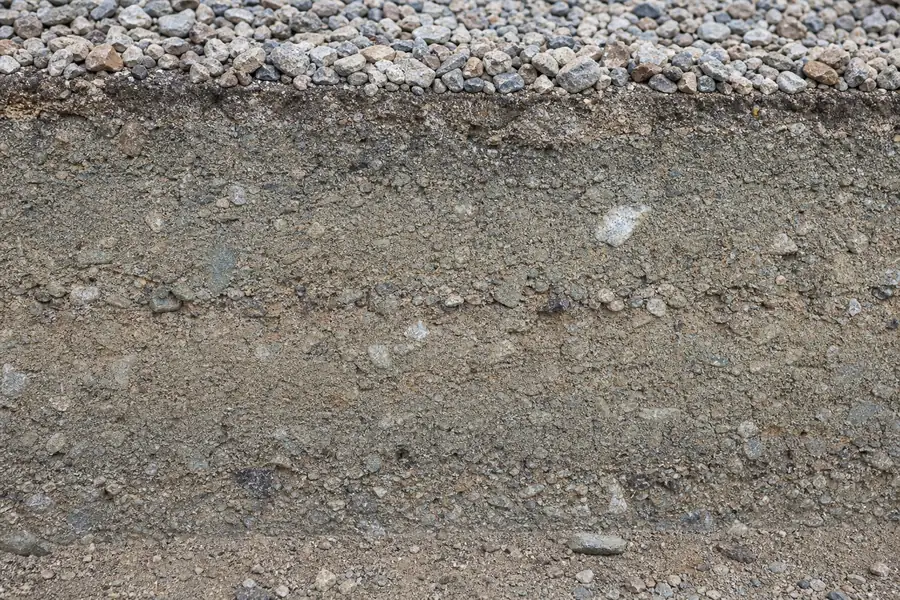
Colorado's 36 inch frost depth is why a thin base fails here when it wouldn't in a milder climate. The compacted base doesn't need to reach frost depth itself, but it does need enough thickness and density to spread the load and shed water before it reaches the clay subgrade underneath.
Front Range soils are heavy clay sitting over decomposed granite, and that combination drains poorly. When spring melt saturates a thin or loosely compacted base, the clay swells, the surface heaves, and cracks or ruts show up by early summer. A properly compacted 6 to 8 inch base moves water down and out instead of trapping it against the clay.
Class 6 Road Base vs. Crusher Fines and Squeegee
Class 6 Road Base is the structural layer that carries load and resists movement; Crusher Fines and Squeegee are surface materials, not substitutes for a base. Crusher Fines pack into a smooth, walkable surface for paths and patios but lack the coarse aggregate structure to hold up a driveway on their own. Squeegee, a 1/4 inch chip, works as a thin leveling layer under pavers or as joint fill, not as the load-bearing course.
Use Class 6 Road Base wherever vehicles, foot traffic loads, or structures will sit for years. Reserve the finer materials for the visible top layer once the base is in and compacted.
Ordering Class 6 Road Base for Your Project
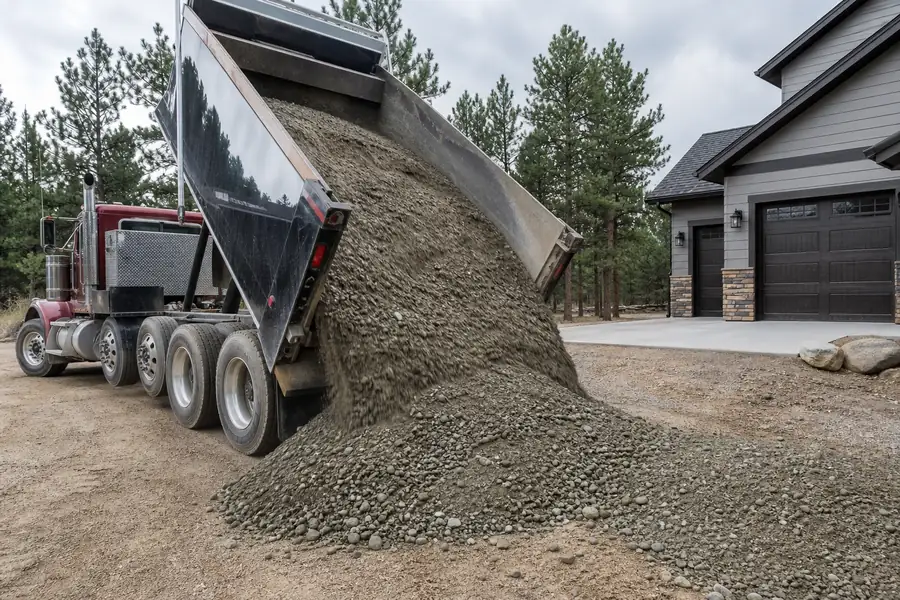
Order Class 6 Road Base before the first hard freeze if your project sits along the I-70 mountain corridor or anywhere above 8,000 feet, since winter closures and frozen ground can push a delivery into spring. Front Range deliveries have more flexibility, but cold, wet soil still makes proper compaction harder.
Check delivery scheduling once you know your tonnage so the load lands when your site is graded and ready. Ordering a little extra, 5 to 10 percent over the calculated amount, covers compaction settling and uneven grading without a second trip.
FAQs
What is Class 6 Road Base made of?
Class 6 Road Base is a dense-graded mix of crushed stone and fine aggregate, typically granite or gneiss quarried in Colorado, sized so the particles lock together tightly when compacted. That gradation is what gives it strength as a subgrade under driveways, patios, and pads.
How deep does road base need to be for a shed foundation?
Most shed and RV pads need 4 to 6 inches of compacted Class 6 Road Base, with the higher end used for heavier structures or softer native soil. A level, well-compacted base prevents the pad from settling unevenly after the first wet season.
Can I compact Class 6 Road Base myself without a plate compactor?
Hand tamping can work for very small areas like a stepping stone path, but anything driveway or pad sized needs a plate compactor or roller to reach proper density. Without mechanical compaction, the base settles unevenly under weight and the surface above it cracks or dips within a season or two.
How does Class 6 Road Base differ from squeegee or crusher fines?
Class 6 Road Base is a coarser, structural aggregate meant to be compacted as a load-bearing subgrade, while squeegee and crusher fines are finer materials used as a top surface or thin leveling layer. Substituting the finer materials for a driveway base leads to rutting because they lack the coarse stone structure to resist compression under weight.
How much does Class 6 Road Base cost in Colorado?
Price per ton varies by quantity, delivery distance, and current material costs, so it's best to get a live quote rather than rely on a fixed number. In general, ordering more tons at once and delivering to a Front Range address rather than a remote mountain site both bring the per-ton price down.